Quote:
20mph zones
There is a legal distinction between a 20mph speed limit and a 20mph zone, as far as signing requirements are concerned. A 20mph speed limit is signed in exactly the same way as any other, i.e. there must be a pair of signs at the point where the speed limit starts, one each side of the road (except in some circumstances within 20 metres of a junction, where only one sign is required — see above), and repeater signs must be provided at intervals.
A 20mph zone, however, must have zone entry signs at each point where drivers can enter the zone. These signs must be in accordance with diagram 674 of TSRGD, instead of the normal sign denoting a maximum speed limit, diagram 670. Zone exit signs, in accordance with diagram 675, should be placed at every exit point, for the benefit of drivers leaving the zone.
Quote:
The remainder of paragraph (4) lists circumstances in which a sign on one side of the road only is required, but these do not apply at the beginning of a speed limit, as the wording of the paragraph makes clear. Direction 8 plainly states, therefore, that there must be a sign on both sides of the road (or both sides of the carriageway, if the road is a dual carriageway) at the point where a speed limit starts.
Unfortunately, there are exceptions to this rule, which are set out in direction 9 of TSRGD. The wording of direction 9 is quite complicated, so its paragraphs are reproduced below, followed by an explanation of what they mean:
(1) Direction 8(3) does not apply where a speed limit in force on the relevant road begins:—
(a) at a point where the relevant road begins, being a point where it has no junction with another road; or
(b) at a point where the relevant road has a junction with another road and the same speed limit is in force on both roads.
The first part of this paragraph simply means that there is no need for a sign to indicate the start of a speed limit at the blind end of a cul-de-sac. The second part means that, where roads intersect and have the same speed limit, there is no need for signs to indicate the start of a speed limit, since there is no change in the limit.
(2) This paragraph applies where the relevant road has a junction ("the junction") with the side of another road ("the other road") and a maximum speed limit is in force on the other road which is different from the speed limit in force on the relevant road.
(3) Where paragraph (2) applies, it is sufficient compliance with direction 8(2), for the purpose of indicating the beginning of the speed limit on the relevant road to traffic entering it from the other road, if the sign shown in diagram 670, 674 or 675 is placed not further than 20 metres from the junction, on the left hand or near side of the carriageway of the relevant road as viewed in the direction of travel of such traffic or, where the relevant road is a dual carriageway road, on the left hand or near side of the carriageway by which traffic may pass into the relevant road from the other road.
Paragraphs (2) and (3) apply where one road has a junction with another and the two roads have different speed limits. Where traffic is turning from a major road with, for example, a 40mph speed limit, into a side turning with, say, a 30mph limit, there only needs to be a single sign at the entrance to the side road to show the start of the 30mph limit. This sign must, however, be on the left-hand side of the road as seen by drivers entering the side road, and it must be no more than 20 metres from the junction with the major road that the driver has left.
(4) Where paragraph (2) applies, for the purpose of indicating the speed limit in force on the other road to traffic entering that road from the relevant road, the sign shown in diagram 670, 674 or 675 shall (subject to paragraph (5)) be placed not further than 20 metres from the junction and so as to be visible to such traffic, on each side of the carriageway by which traffic may pass from the relevant road into the other road.
(5) Paragraph (4) does not apply if:—
(a) the maximum speed limit in force on the other road is greater than that in force on the relevant road; and
(b) signs indicating the maximum speed limit have been placed on the other road in accordance with direction 11 on each side of, and not more than 100 metres from, the junction.
Paragraphs (2), (4) and (5) also relate to the situation where one road joins another and the two roads have different speed limits, but they deal with the signs needed to advise drivers travelling in the opposite direction, i.e. from the side road into the major road. The requirement (paragraph (4)) is for a sign to be placed on both sides of the side road on the approach to the major road, but not more than 20 metres from the junction, to show the speed limit on the major road. This only applies, however, if the speed limit on the major road is lower than that on the side road. If the speed limit on the major road is higher than that on the side road (paragraph (5)), no signs are required at all on the approach to the junction, provided there is a speed limit repeater sign on the major road not more than 100 metres from the junction, and in both directions of travel.
Presumably the thinking behind this exception is that drivers entering the major road will assume that the speed limit has not changed, until they see a speed limit repeater sign. If the major road is of a much better standard than the side road, however, drivers are likely to expect that a significantly higher speed limit applies and could accelerate to above the actual limit before they see the first repeater sign. The real purpose, of course, is to save the highway authority money in the provision of signs.
http://www.abd.org.uk/index.htm Signing Requirements for Speed Limits

 Login
Login Register
 FAQ
FAQ Search
 Members


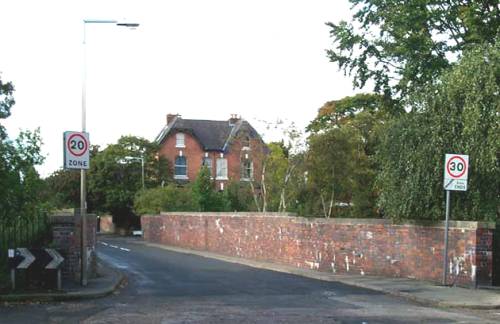


 It's a matter of signage and clarity to the road user


