|
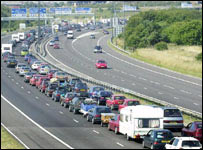
Responding to Sixy's earlier point, I like to maintain a stopping distance so that I won't have to brake too harshly in the event of something happening ahead. I will stick with Sixy's "about a second apart". I expect I'll ge flack for saying that generally I think 1 sec is just about enough at 40-50 if one is concentrating, and in good visibility, and in dry conditions with low hazard density, and the gaps for the next few pairings in front are a second or more also. Personally I try to have a greater margin - 2 sec in the dry - to maintain smoother progress.
However, when a biker (or a car) in one of the few pairings in front of me is closer than a second apart, which is not compensated for by a sunstantially larger gap in a pairing more immediately in front of me, risk of having to anchor up is dramatically increased. When a biker (or a car in a hurry) leapfrogs cars in such a queue, by definition, he punctuates a gap previously of 1 s to two gaps, at least one of which will be substantially below half a second. Until that double small gap has made it substantially in front of me (by leap-frogging at least another dozen vehicles) or turned into a decent sized pair of gaps by, eg, a double white line and the biker backing off to a second or so behind his/her next quarry and the last-leapfrogged car in turn backing off even more, I will be compensating for this "double whammy" by upping my following distance substantially - 3 - 4 seconds is quite realistic at 50 in such circumstances as far as I'm concerned, progressively reducing as the bike reaches the "disappearing point".
So, in a row of safe thinking drivers, the "making progress" biker has done so at the expense of a lot of motorists creating artificially large gaps with the correspondding peristaltic wave being driven backwards, possibly causing the queue to even halt temporarily a few hundred yards behind (and out of the biker's visibility).
One technique a car driver can use to mitigate this is, when he spies the biker's antics several cars behind, to make a large gap pre-emptively by easing back almost imperceptibly, several leapfrog slots before the biker reaches the gap in front of the car, to make room for the leapfrgoeer and still leave a decent time margin behind and in front of it ,if it needs that respite. If it does not need that gap, but needs the one in front, say, when the one in front drops back, the discerning car driver will have already been back to give this slack, and effectively will have prevented the otherwise inevitable peristaltic wave created by the faster leapfrogging vehicle.
|

 Login
Login Register
 FAQ
FAQ Search
 Members