Safe Speed Forums

The campaign for genuine road safety
It is currently Tue Jun 09, 2026 17:14

All times are UTC [ DST ]


Post new topic Reply to topic  [ 8 posts ] 
Author Message
PostPosted: Fri Jul 16, 2010 11:50 
Offline
Site Admin
User avatar

Joined: Tue Oct 12, 2004 02:17
Posts: 7357
Location: Highlands
I know that this has been touched on by various people but there is a growing interest I feel in this ...
I have had a small discussion on this here but have been collating data and feel it worthy of listing in here for reference and discussion.

Pepipoo here
ACPO listed Guidelines via Pepipoo here
Daily mail report to Hampshire Solicitor [quote=Daily Mail]But that is contradicted by a letter from Geoffrey Biddulph, the senior Home Office civil servant in charge of policing Britain's roads.
In it, he states clearly:
Geoffrey Biddulph wrote:
"We do accept in certain atypical circumstances a device may be capable of producing inaccurate readings."
Here
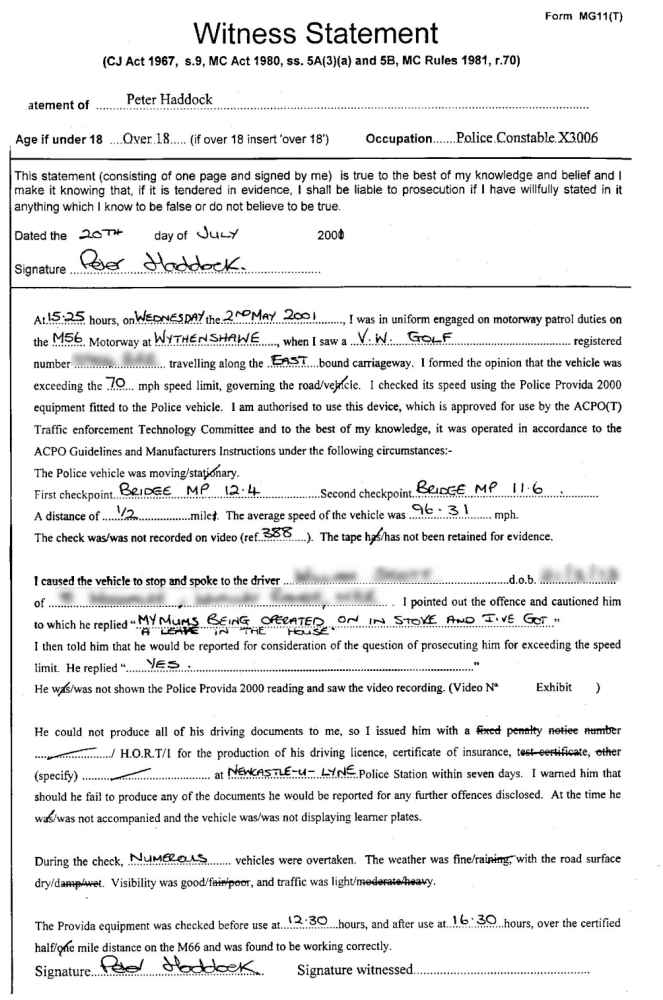
pepipoo showing a Policeman's Forum Here where they normally include "I formed the opinion that the vehicle was exceeding the speed limit".
ACPO Manual Guidelines : Here (via Pepipoo)
Honest John's
Honest John wrote:
SPEEDING DEFENCES 3: Is incorrect use of a speed measuring device a valid defence against conviction for speeding?
here

Blake Lapthorn Law Here where in one of the cases states :
Blake Lapthorn Law wrote:
speeding on A303
Barry Culshaw of our Motoring Offences team based at our Southampton office was consulted by P who had been summoned before Salisbury Magistrates Court in regard to an allegation brought by Wiltshire Constabulary of speeding on the A303 near Andover, Hampshire. The prosecution alleged that P was exceeding the 70 mph national speed limit for a dual carriageway by travelling at 104 mph. P was adamant that he was complying with the speed limit at the material time. The prosecution claimed that the police officer's prior opinion of excess speed was corroborated by a speed reading produced by an LTI 20:20 TSM speedscope laser speed measuring device. An expert's report was commissioned. Barry Culshaw, an experienced road traffic lawyer, represented P at trial where he was found not guilty, the court ruling that P was a credible and convincing witness, that there were breaches on the part of the police in complying with the relevant ACPO Code of Practice and the court could not be sure that it was P's vehicle that had produced the speed reading due to multiple vehicles in the vicinity of his vehicle at the time of the check and having regard to the beam spread of the laser beam at the distance at which P's vehicle had been targeted namely 676.5 metres.
[my bold] so this showed that in spite of a claimed prior opinion the error resulted from multiple possible readings, which is also a performance error.

So how can one prove that a prior opinion has happened. From much of the video evidence that I have seen, it rarely looks like it happens at all and is more of an after thought, to fit the facts, potentially.
Should better processes be in place since it needs to be formed 'prior' to the back up process ?

_________________
Safe Speed for Intelligent Road Safety through proper research, experience & guidance.


Top
 Profile Send private message  
 
PostPosted: Fri Jul 16, 2010 14:17 
Offline
User

Joined: Wed Jul 14, 2010 15:33
Posts: 115
Clearly, it is hard to have a prior opinion and the maximum range of say an LTI 20-20. The other big problem is proving, in any real sense, that a prior opinion was ever formed. If the camera had a recording device built in that recorded a verbal comment by the operator of the prior opinion, I think that this would help.

_________________
http://kalvis.com/


Top
 Profile Send private message  
 
PostPosted: Fri Jul 16, 2010 14:42 
Offline
User

Joined: Thu Jan 11, 2007 02:25
Posts: 331
SafeSpeedv2 wrote:
Should better processes be in place since it needs to be formed 'prior' to the back up process ?

Yes. How that process is implemented is the problem.


Top
 Profile Send private message  
 
PostPosted: Fri Jul 16, 2010 15:46 
Offline
Gold Member
Gold Member
User avatar

Joined: Wed Dec 08, 2004 14:26
Posts: 4364
Location: Hampshire/Wiltshire Border
Don't we all know this "prior opinion" stuff is just a legal nicety to make the chosen system of mobile enforcement comply with the pre-existing laws? Does anyone really believe that camera operators look first before pulling the trigger? Can anyone viewing from a few hundred yards in front of an approaching vehicle tell the difference between 30mph and 36mph?

My answers are yes, no and no.

Practically nobody should be caught at 36mph by a mobile unit as it is impossible to tell at a glance if someone is over a 30mph limit. The original laudable idea was to spot the gross speeders and get them ... but that's not how it turned out is it?

_________________
Malcolm W.
The views expressed in this post are personal opinions and do not represent the views of Safespeed.


Top
 Profile Send private message  
 
PostPosted: Fri Jul 16, 2010 16:07 
Offline
Site Admin
User avatar

Joined: Tue Oct 12, 2004 02:17
Posts: 7357
Location: Highlands
:welcome: trakgalvis

trakgalvis wrote:
Clearly, it is hard to have a prior opinion and the maximum range of say an LTI 20-20. The other big problem is proving, in any real sense, that a prior opinion was ever formed. If the camera had a recording device built in that recorded a verbal comment by the operator of the prior opinion, I think that this would help.
However that might still be abused as it can be 'easy' to 'claim' any speed, hence why trust, respect and honour are so crucial for the Police Forces to retain and hold. Without it we question the truth, and especially when numeric values have become the soul aim.
The Law requires a prior opinion, but how can it be best quantified in legal terms ?

_________________
Safe Speed for Intelligent Road Safety through proper research, experience & guidance.


Top
 Profile Send private message  
 
PostPosted: Fri Jul 16, 2010 18:10 
Offline
Site Admin
User avatar

Joined: Tue Oct 12, 2004 02:17
Posts: 7357
Location: Highlands
Since this thread on government transparency here has got rather 'side-tracked' perhaps we can discuss this here ... I have pointed to several references about procedure, siting ACPO Guidelines, Operating Manual and trakgalvis has offered up "amended Section 20 of the Road Traffic Offenders Act 1988, arriving as Section 23 of the Road Traffic Act 1991, c.e.f. July 1992".
What else is there ? Anyone got any ideas of links in with the Police to know what they (may) teach ?
It would be nice to know ...
After all if the Court is claiming that a prior opinion is required then how can it be quantified when required to do so in Court ?
perhaps that is a Law that needs to be clarified. I do think that it is important to retain and manage better.

Edited to add - also this Operation Manual states :
[quote=Tele Traffic Speedscope manual]This Operations Manual has been designed to meet the requirements of the Traffic
Committee of the Association of Chief Police Officers and will provide all the detail that a trainer will need.[/quote]

_________________
Safe Speed for Intelligent Road Safety through proper research, experience & guidance.


Top
 Profile Send private message  
 
PostPosted: Sat Jul 17, 2010 18:28 
Offline
Life Member
Life Member
User avatar

Joined: Sat Apr 30, 2005 22:02
Posts: 3266
I have a dvd with the stats on the end of the dvd where the prior opinion show just how good or bad the opinion was.

Each atempted ping is recorded. some motorists may have been pinged time and time again.
Ie a car traveling at 29mph could be prior opinioned 5 times untill the desperate opperator is lucky enough to cross a lamp post or a car passes through the frame and a slip error occurs.

I have a prosicution dvd where a van and a pedestrian goes through the frames prior to sucessfull ping.

_________________
Speed limit sign radio interview. TV Snap Unhappy
“It has never been the rule in this country – I hope it never will be - that suspected criminal offences must automatically be the subject of prosecution” He added that there should be a prosecution: “wherever it appears that the offence or the circumstances of its commission is or are of such a character that a prosecution in respect thereof is required in the public interest”
This approach has been endorsed by Attorney General ever since 1951. CPS Code


Top
 Profile Send private message  
 
PostPosted: Sun Jul 18, 2010 03:36 
Offline
Site Admin
User avatar

Joined: Tue Oct 12, 2004 02:17
Posts: 7357
Location: Highlands
Anton van I get a copy of that please ?

This Here : http://www.teletrafficuk.com/pdf/speedscope_manual.pdf is the Operators Manual which states that :
Quote:
LTI 20.20 TS/M SPEEDSCOPE OPERATIONS MANUAL 2008
...
CALIBRATION
Because a radio frequency is not used there is nothing in the instrument that can drift out of frequency. Therefore the tests mentioned above and the scope alignment test represent the majority of the calibration required. The speed calculations are referred to a crystal control time base which is guaranteed to have less than 100 parts per million (PPM) error over the full operating temperature of the instrument. Therefore additional calibration is not necessary but if verification of calibration is desired the following steps can be followed to verify proper calibration
of the range and timing accuracy of the instrument. These two functions are the two elements that calculate the speed measurement.
- 17 -
This can be done by following the procedures listed below:
a. Establish a known distance between two stationary points. For example this could be done with a metal tape measuring between a designated point on which the operator will stand and a sign or a telephone pole. The ranging accuracy of the Laser can be checked by having the operator stand on the designated point, aim the Laser at the target (whether it be a sign or telephone pole) pull the trigger and a "0" reading should be displayed for the speed measurement. By pressing the speed/range button the Laser should then display the correct distance.
The timing accuracy of the instrument is verified by the "0" speed measurement. An accurate "0" reading of a stationary target is identical in nature to an accurate 50mph reading of a moving vehicle. By verifying the ranging and timing accuracy of the instrument with the above test the two elements used to measure velocity have been checked and proper "calibration" is verified.
b. If additional verification is desired the instrument can be checked against a calibrated speedometer by shooting a stationary target from a moving vehicle and comparing the speedometer of the vehicle against the Laser. The stationary target is subject to the normal cosine error limitations and must be within a 10° angle off the road.
The LTI 20.20 TS/M Speedscope is not susceptible to radio frequencies and electromagnetic interference, therefore,


and
here ACPO Traffic Committee - Enforcement Technology National Guidance Manual
Quote:
12, EVIDENCE
12.1
Presentation of Evidence
(a) The eventual success of any prosecution depends upon accurate observations by the officer operating the device and the professional presentation of evidence before the Court. It is in this area that the integrity of devices will be closely scrutinised.
(b) Operators should not only record evidence concerning the target vehicle, such as speed, direction of travel etc., but additionally, note the presence of any other vehicle in the vicinity, which may be used in defence when contradicting prosecution evidence.
Note: The need to document all evidence is obvious as the memory of the operator must dim with the passing of time.
(c) It must be remembered that the evidence of the equipment is only CORROBORATION of the operators prior opinion that the target vehicle was travelling in excess of the permitted speed limit for the road or class of vehicle.
(d) If the operator has any doubt as to the validity of the reading obtained by the device in comparison to his personal estimation of the speed of the target vehicle, then he will abort the check.
(e) Operators of devices should normally do so from positions where they will be clearly visible to the public.
(f) The target vehicle must be kept within direct sight of the operator of the device at all times throughout the period of observation and check.
(g) Positive identification of the target vehicle must be made by the device operator, to enable any enforcing officer to identify and process an offender.
(h) Whilst no legal requirement exists for the accused driver to be shown the speed recorded on the device, whenever this is possible he should be given that opportunity.
(Westwater -v- Milton, 1980).
(i) A trained police operator must necessarily be aware of the basic technical functions of the device. However, it is stressed that he is not technically qualified to give evidence on principles of the system nor the internal workings of the device. If such evidence is required, then an expert witness must be called.

_________________
Safe Speed for Intelligent Road Safety through proper research, experience & guidance.


Top
 Profile Send private message  
 
Display posts from previous:  Sort by  
Post new topic Reply to topic  [ 8 posts ] 

All times are UTC [ DST ]


Who is online

Users browsing this forum: No registered users and 22 guests


You cannot post new topics in this forum
You cannot reply to topics in this forum
You cannot edit your posts in this forum
You cannot delete your posts in this forum
You can post attachments in this forum

Search for:
Jump to:  
Powered by phpBB® Forum Software © phpBB Group
[ Time : 0.014s | 10 Queries | GZIP : Off ]