Oh crap! I've edited this post instead of quoting from it and lost most of it. I'll have to rewrite it.


Edit: near as I can make thanks to basingwerk quoting the original, it went something like this:
basingwerk wrote:
Gatsobait wrote:
It's well known that our orbit is subject to cycles that can cause huge variations - probably the last ice age was one, and we're still recovering from that (as well as the C18th Little Ice Age).
Are you referring to nutation and precession perturbations? Precession has a phase of 27,000 odd years, and the poles of the orbit describe a cone in that period. I have never heard it said that it caused an ice-age. I think of Nutation, which has a period of 18.6 years, as a wobble on top of the precession, and again, it's effects are not cataclysmic in any sense at all.
Nope, well, not so much as 100,000 year eccentricity one, which is the monster for major changes. I take your word for the length of the precession cycle, though I read earlier that it was 23,000 years. I don't know if precession and nutation would cause an ice age by themselves, but remember that they will enormously effect where the suns energy lands, which in turn could change the surface albedo. Off the top of my head I imagine if they resulted in ice further south than we have at the moment more radiation will be reflected off the surface, which makes it colder, which brings more ice, which... feedback can work both ways you know. Has it happened and will it happen? Dunno, I need to read more.
basingwerk wrote:
Gatsobait wrote:
Solar output varies on a number of cycles too, the shortest of which is the 11 year long sunspot cycle, and as that can be a year or so longer or shorter a direct natural variable can produce changes in less than a decade.
Solar max happens every 11 years. One was in 1989, and another in 2000. It does have significant effects on solar radiation pressures on panels, which effects attitude and station keeping quite a bit. It can knock the orbit of a spacecraft around quite a lot, but again, it's climate effects are transient, not cataclysmic and not accumulative.
That's just the sunspot cycle, which itself is a component of a larger cycle. During the Little Ice Age the 11 year cycle took a few decades off IIRC (the Maunder Minimum). Of course it's no more true to say that particular correlation was also the causation than it is for CO2 and warming.
BTW, apologies for my misuse of terms earlier. I forgot we should be referring to aphelion and perihelion.
I've since read that there is another short term solar cycle of about 20 years and a more mid-term one of a couple of centuries. That reminded me of something on the BBC a while back about the sun currently being at it's most active for 1000 years. Perhaps this is the sun's version of that biorythms idea than was going round some years ago. Some times all three cycles will hit their maxima at the same time, or their minima for that matter.basingwerk wrote:
Gatsobait wrote:
Other natural events can have a short-term effect as well. I think Krakatoa and Mount St. Helens both had widespread effects, didn't they? Then there's things like the Tunguska(sp?) event when something went bang in a big way in Siberia.
You are starting to get up to the block now. Mount St. Helens is beginning to match up to the C02 problem, but is still transient in comparison. As far as I can recall, it may have affected the figures for a few years, but even that totally paled into insignificance against the backdrop of global industrial output after a year or two or certainly a decade.
I did say short term effects, didn't I. Individually, yes, anthropogenic sources would soon have overtaken these natural ones. But don't forget that the natural ones have been going since year dot and will continue to do so.
basingwerk wrote:
Gatsobait wrote:
It goes without saying that the scariest scenarios tend to be in the newspapers, as reporting on a model that says nothing much is going to happen won't sell any extra copies.
Are there any model that says nothing much is going to happen?
I'll have to get back to you on that. I have certainly seen some that look pretty tame compared to the ones that get reported in the media.
basingwerk wrote:
Gatsobait wrote:
The reality hasn't got remotely near their worst predictions (or projections or scenarios or whatever they call 'em next )
Time was when we didn?t need air conditioners in this country!
Oh we needed 'em alright - we just didn?t have them. I reckon they'd have been handy in Roman times, the medieval period, and even the 1930s.
basingwerk wrote:
Anyway, let's get back to the recent 40% rise - do you expect anyone to believe that this it not industrial output? What about the 20% rise in our lifetimes - have you brushed it under the carpet?
No, it's still on the sofa. I need to do some more hunting for that. A lot of my bookmarks are dead links and stuff has moved elsewhere (that'll teach me to save interesting pages, but I'm such a tightwad with drive space, particularly when I've got so many big image files). However, I remind you that recent papers show CO2 rises after temperature increases, and that post-Little Ice Age a temperature rise was a virtual certainty. And what would that mean?
Quote:
Indy, they're digging in the wrong place.
_____________________________________________________________
Can't believe I've had to do that again. What a


 Login
 Register
 FAQ
 Search
 Members


 is no differant.


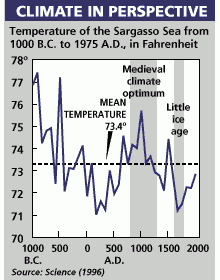


 particularly when I've got so many big image files). However, I remind you that recent papers show CO2 rises after temperature increases, and that post-Little Ice Age a temperature rise was a virtual certainty. And what would that mean?