Steve wrote:
What of the idea of pulling any (repeatedly, continuously, or stubbornly) errant motorway driver and mandate that they must attend/pass a motorway lesson/test within a certain date? Non-attendance/failure of that course could result with legal exclusion from motorways (which could be fairer than points, fine or revocation of licence). This assumes use of trafpol, as opposed to cameras, of course.
Assuming they were effectively excluded from the motorways, they might wind up worse off on rural and local roads. Or, they might not.
The ones that would pose no additional risk to themselves or others on rural and local roads would likely prove such after comprehensive and thorough testing. If the only place that they ought not drive truly turns out to be motorways and dual carriageways, the only thing left to determine is how suitable those rural and local roads in fact are to handling those who now legally must avoid M-ways and DC-ways.
Even if the M-way/DC-way test transfers precisely the correct number of people to rural and local roads, could those roads handle even that many more drivers? At best, they might not add any additional danger to these roads, but that's unlikely; they'd probably add some, even if just by being there (unless they were truly awesome drivers otherwise).
The ones that would probably wind up worse off on rural and local roads are the ones that have a greater need to either be remedially retrained, or banned outright. (Keep in mind that they've already disqualified themselves from M-ways/DC-ways.) Transferring such 'drivers' to rural and local roads would absolutely add more danger than was removed from the M-ways/DC-ways; the only question would be, "Was the danger increased by an integer, a factor, or an exponent?"
Thus, the test should not merely be to see if they are qualified to use the M-ways/DC-ways. They should be retested thoroughly and comprehensively. To be logical and fair to everyone else, everyone else who has to take a road test, should have to take the same road test when they'd normally be required to do so.

 Login
Login Register
 FAQ
FAQ Search
 Members


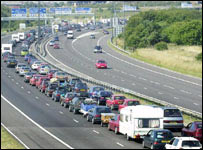
 ) is a motorway from a good quality DC? Roughly what proportion of the UK population are more than an hour's drive from a good DC?

 really aren't warming to my view. Perhaps a compromise is to pull any (repeatedly, continuously, or stubbornly) errant motorway driver and mandate that they must attend/pass a motorway lesson/test within a certain date?

