The Newspaper
hereStopBigBrother.org wrote:
Maryland: Forest Heights Speed Camera Accuracy Questioned
An extensive investigation of inaccurate speed camera readings in Forest Heights, Maryland.
Forest Heights speed cameraBy StopBigBrotherMD.org
The accuracy of the speed cameras deployed by Forest Heights on Indian Head Highway (State Highway 210) has been questioned by local residents were claiming innocent drivers were being ticketed. Citation photos appear to show many cases that speed cameras in Forest Heights cited vehicles for speeds far in excess of the speeds the citation images indicate.
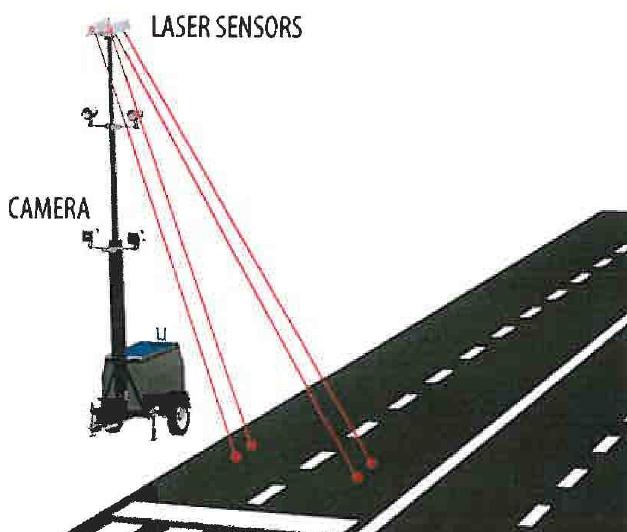
First, Forest Height's speed cameras are a proprietary design by Optotraffic, a division of Sigma Space Corporation. These cameras are neither radar (like most cameras used in Montgomery County) nor are they exactly like traditional police LIDAR. Technical specifications for Optotraffic's cameras can be viewed here.
To simplify it, Optotraffic's cameras work by taking two laser sensors into each lane of traffic. The device "records the time when each sensor detected the object." The speed is then calculated as "Measured Speed = Distance/Time." If a vehicle is determined to be exceeding a predefined threshold speed, a short distance/period of time later the device snaps two photos a fraction of a second apart.
So why would someone think the devices are inaccurate? Well, because many people have gotten tickets from Forest Heights for speeds they know they were not traveling at. Some of them performed their own distance/time calculations from the citation images which produced an extremely different speed than what they were cited for.
Speed camera images are typically taken a few tenths of a second apart, so the distances traveled are fairly short (tens of feet). Getting exact distances from photos can be difficult, so it is hard to convincingly prove the speed measurement was in error unless it was off by a large amount. If the speed camera was off by say 5 MPH then proving yourself innocent this way would be hard (and proving yourself innocent is exactly what you would be required to do in court). Assuming large errors are sporadic (as opposed to a device which always produced an incorrect result), any one specific person would be unlikely to get enough citations with extremely large errors in order to prove the existence of a pattern.
A local business owner, Will Foreman of Eastover Auto Supply in Oxon Hill, maintains a small fleet of vehicles that must drive up and down Indian Head Highway in Forest Heights several times per day and as a result received a large number of citations for that fleet. He later discovered that other enraged citizens had also received questionable tickets. Many of the photos clearly show the speed measurements are much higher than the distances traveled between the citation images.
(continued...)
Article Excerpt:
The formula for distance traveled between frames would be :
Feet Traveled = (MilePerHour * (5280 ft/Mile) / (3600 s/Minute)) * photo_interval
The citation images below were all found to have a photo interval of 0.363 seconds between frames according to the timestamps on the images. Our first citation stated the vehicle was traveling at 56 MPH
Example 1: Image #1
Example 1: Image #2
That works out to 56 *5280/3600 * 0.363 = 29.18 feet. By superimposing the vehicle from the second image over the first, you can see the distance traveled:
Example 1: Both Images
The length of this pickup is about 16 feet, meaning the truck should have traveled 1.82 truck-lengths (or 1 length, plus another 13.18 feet) to move at this speed. We've added guidelines to compare the image, showing that the distance is one length, plus the gap between the front and back of the two truck images. That gap is much less than half a truck-length. We estimate this to be less than 4 feet based on the size of the wheel-wells. That would work out to a total distance of less than 20 feet, which given the interval of 0.363s would be just under 38 MPH. This indicates an error of 18 MPH, and a speed 9 MPH below the threshold for issuing speed camera tickets under state law (47 MPH in this case).
Our second example is even more obvious. This truck was measured by the device to be traveling 65 MPH on July 28, 2010.
Example 2: Image#1
Example 2: Image#2
As such should have traveled 34.6 feet, which given this vehicle's length of no more than 16 feet it it should have traveled at least 2.1 truck-lengths. Superimposing those two images, you can see that this distance is not even close that distance.
Example 2: Both Images
In fact, the front of the vehicle in the first image is almost perfectly lined up with the back of the truck in the second frame, meaning the vehicle only traveled about 16 feet. That gives us a vehicle speed of:
16ft/0.363s)*(3600s/hr)/(5280ft/mi) = 29.88 MPH
It would seem that even driving 5 MPH below the speed limit might not get you past these speed cameras without a fine.
Another example which took place on September 9, 2010 showed a van which was clocked at 51 MPH and therefore should have traveled 27.15 feet between images.
Example 3: Both Images
This van is about 17 feet long so it should have traveled 10 feet longer than one length based on the recorded speed. As you can see, the front of the first superimposed van image is almost aligned with the back of the second van image. The van couldn't have traveled more than one or two feet more than one van-length, placing its speed right around 35 MPH, a difference of close to 16 MPH compared to the recorded speed.
Optotraffic told The Washington Post was that the company's cameras "accurately measure vehicle speed within .5 MPH below speeds of 55 miles per hour." Well if they said that it must be true, right?
Example 4: Both Images
But the most compelling image is this one, dated July 22, 2010, showing both an Auto Value truck and a Metro bus. The citation charged this pickup truck with traveling 76 miles per hour. The 0.363 photo-interval means the vehicle should have traveled 40.46 feet which is more than 2.5 truck-lengths. The superimposed images clearly show the actual distance to be a little more than one truck length, less than 20 feet total -- not even half the distance it should have traveled at 76 MPH. (We note that the bus in the right lane traveled a bit over half its length, and this would also have been well under 40.46 feet. So while one could consider whether this one was possibly a matter of incorrect lane assignment, even if that were the case the bus was also traveling much less than 76 MPH.) Mr. Foreman hung this last photo in his shop for some time to protest what he called the "Indian Head Highway Robbery."
We have received many other examples of this from other drivers in the area. The amount discrepancy varied from case to case but one thing is clear: the speed cameras in Forest Heights are not consistently producing accurate speed measurements. While the majority of documented cases occurred in the summer of 2010, some questionable photos were dated in December, meaning that whatever issue caused these errors it is likely still there.
Mr. Foreman's business was adversely affected by what they now refer to as the Forest Heights Toll Plaza. When the tickets first started to arrive he took the matter up with his employees and warned them about speeding, holding them responsible for paying the tickets. However even though the drivers all knew about the camera locations, the tickets kept coming. When he learned that the vehicles had in fact not been traveling the speeds they were cited for he realized he had been disciplining employees for something which was beyond their control. That is not a good position for an employer to find himself in. Some members of his staff who need to do deliveries now drive far out of their way to avoid the "Forest Heights Toll Plaza" even though this costs the business time and money.
Similar cameras are used in many other municipalities in Prince George's County, including College Park, Riverdale Park, New Carrollton, Berwynn Heights, and Mount Rainier. There have been specific reports of errors from these cameras documented in Brentwood, Riverdale Park, and Cheverly.
When a similar situation was investigated in Cheverly, the response from the company was that the vehicles had simply decelerated between the time the speed measurement was taken and the time the photos were taken. There are three problems with this. First, in the above photos, the vehicles do not appear to have their brake lights on. Second, the vehicles simply did not have enough time. A typical deceleration rate for a car or light truck is around 25 feet per second per second. Looking at our last example, decelerating from 76 MPH (111 fps) to 35 MPH (51fps) would take 2.4 seconds. The vehicle would have traveled about 194 feet, or twelve truck lengths, in that amount of time. The actual distance between the camera and the photo position is only a small fraction of that distance. Lastly, Optotraffic's own documents state that citation images can be used for speed verification: "While the primary evidence for issuing a speeding citation is the calibrated Lane Sensor, the two photos provide the secondary evidence of speeding that is presented to the citation recipient... Since a stationary object is present along with the vehicle, a photographic method also determines speed, guaranteeing fairness."
But wait a minute, the machines are tested for accuracy: Doesn't that means they cannot possibly be wrong? According to the system spec of the similar Optotraffic cameras used in Brentwood: "Each Lane Sensor is third-party calibrated annually (by Maryland law) to verify the beam distance; in addition, the relative time between the sensors is calibrated daily using the 1 pulse-per-second (PPS) signals from the Global Positioning System (GPS) satellites" That sounds very impressive, but notice that this only means they have calibrated the system's components. The spec does not state whether the device is actually tested as a complete system under real world conditions. Whatever actual (unspecified) speed testing did take place, it seems unlikely that it was tested with thousands of vehicles of different configurations, sizes, two vehicles passing at the same time, etc. under a variety of conditions and confirming that none of their speeds were incorrectly measured. So at best, the devices were tested for "accuracy" under "controlled conditions", but not for consistent accuracy under real world conditions. Just because a device works correctly sometimes under perfect conditions does not mean that it works right every time under all conditions.
Likewise, the device "has a test mode that runs daily to verify the basic functionality of the data processing unit and calibration of the Lane Sensor." A sample output is shown at right.
If it is tested every day then it must be accurate, right? But wait a minute, how could an automatic test POSSIBLY be checking the accuracy of speed measurement against a REAL moving vehicle of known speed? Did they arrange for one to automatically drive past at precisely 35 MPH the same time every day? Unlikely. The answer is that it is not. It is merely testing that it has a GPS signal and that various components are "working." The chart showing the "speed error" may seem very technical and is made to appear like meaningful testing is being done for when they present it as evidence in court, but no actual speed measurements on any vehicle is part of this self-test.
Laboratory tests or component tests may be over-simplifying what happens in the real-world, the way the teacher of a first year physics class would simplify a problem for his students with massless frictionless pulleys, and falling bodies in a perfect vacuum. In the real world the device needs to take many variables into consideration. If the lasers do not use the same point on the vehicle for both measurements the device may not calculate a correct speed, regardless of how accurate the individual components are or how often they are tested. Did both laser-sensors strike the same point? Was this an unusually shaped vehicle like a truck, a motorcycle, or an RV pulling a trailer? Could the device's 32-foot telescoping pole start to sway or vibrate due to high winds or a passing truck, and would this affect the angle of the beams? Could something other than a vehicle interrupt a beam? And would any such problem be likely to present itself in a limited number of controlled tests?
So who is investigating what is going on? Only the town of Forest Heights and its contractor who each, have a substantial financial stake in finding that there is no problem.

 Login
Login Register
 FAQ
FAQ Search
 Members