LEGAL CHALLENGE
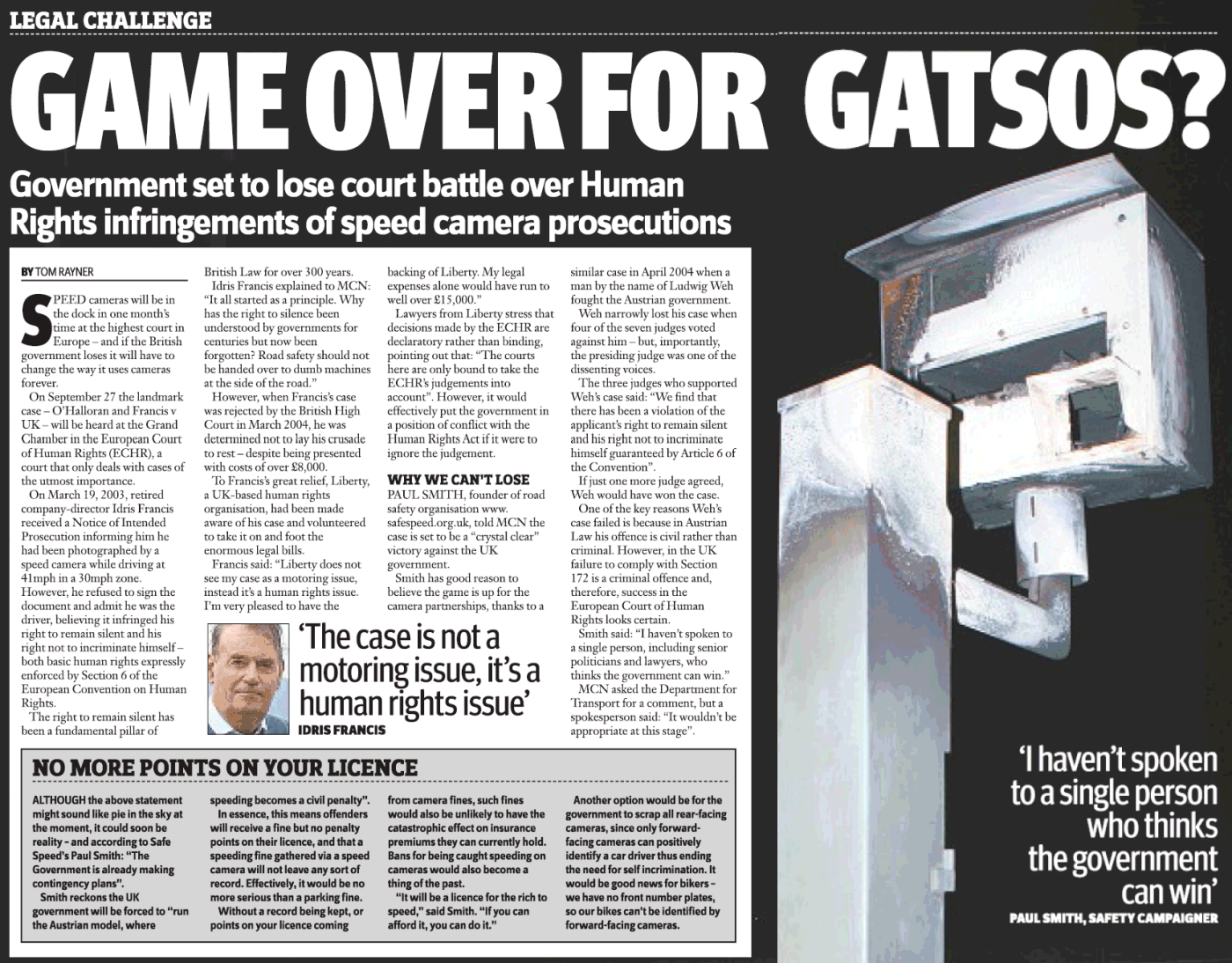
GAME OVER FOR GATSOS?
BY TOM RAYNER, Motor Cycle News, Wednesday, August 30, 2006
Government set to lose court battle over Human Rights infringements of speed camera prosecutions.
`The case is not a motoring issue, it's a human rights issue' (With picture of IDRIS FRANCIS)
SPEED cameras will be in the dock in one month's time at the highest court in Europe - and if the British government loses it will have to change the way it uses cameras forever.
On September 27 the landmark case - O'Halloran and Francis v UK - will be heard at the Grand Chamber in the European Court of Human Rights (ECHR), a court that only deals with cases of the utmost importance.
On March 19, 2003, retired company-director Idris Francis received a Notice of Intended Prosecution informing him he had been photographed by a speed camera while driving at 41 mph in a 30mph zone.
However, he refused to sign the document and admit he was the driver, believing it infringed his right to remain silent and his right not to incriminate himself - both basic human rights expressly enforced by Section 6 of the European Convention on Human Rights.
The right to remain silent has been a fundamental pillar of British Law for over 300 years.
Idris Francis explained to MCN: "It all started as a principle. Why has the right to silence been understood by governments for centuries but now been forgotten? Road safety should not be handed over to dumb machines at the side of the road."
However, when Francis's case was rejected by the British High Court in March 2004, he was determined not to lay his crusade to rest - despite being presented with costs of over £8,000.
To Francis's great relief, Liberty, a UK-based human rights organisation, had been made aware of his case and volunteered to take it on and foot the enormous legal bills.
Francis said: "Liberty does not see my case as a motoring issue, instead it's a human rights issue.
I'm very pleased to have the backing of Liberty. My legal expenses alone would have run to well over £15,000."
Lawyers from Liberty stress that decisions made by the ECHR are declaratory rather than binding, pointing out that: "The courts here are only bound to take the ECHR's judgements into account". However, it would effectively put the government in a position of conflict with the Human Rights Act if it were to ignore the judgement.
WHY WE CAN'T LOSE
PAUL SMITH, founder of road safety organisation
www.safespeed.org.uk , told MCN the case is set to be a "crystal clear" victory against the UK government.
Smith has good reason to believe the game is up for the camera partnerships, thanks to a similar case in April 2004 when a man by the name of Ludwig Weh fought the Austrian government.
Weh narrowly lost his case when four of the seven judges voted against him - but, importantly, the presiding judge was one of the dissenting voices.
The three judges who supported Weh's case said: "We find that there has been a violation of the applicant's right to remain silent and his right not to incriminate himself guaranteed by Article 6 of the Convention".
If just one more judge agreed, Weh would have won the case.
One of the key reasons Weh's case failed is because in Austrian Law his offence is civil rather than criminal. However, in the UK failure to comply with Section 172 is a criminal offence and, therefore, success in the European Court of Human Rights looks certain.
Smith said: "I haven't spoken to a single person, including senior politicians and lawyers, who thinks the government can win." MCN asked the Department for Transport for a comment, but a spokesperson said: "It wouldn't be appropriate at this stage".
NO MORE POINTS ON YOUR LICENCE
ALTHOUGH the above statement might sound like pie in the sky at the moment, it could soon be reality - and according to Safe Speed's Paul Smith: "The Government Is already making contingency plans".
Smith reckons the UK government will be forced to "run the Austrian model, where speeding becomes a civil penalty".
In essence, this means offenders will receive a fine but no penalty points on their licence and that a speeding fine gathered via a speed camera will not leave any sort of record. Effectively, it would be no more serious than a parking fine.
Without a record being kept, or points on your licence coming from camera fines, such fines would also be unlikely to have the catastrophic effect on insurance premiums they can currently hold. Bans for being caught speeding on cameras would also become a thing of the past.
"It will be a licence for the rich to speed," said Smith. "If you can afford it, you can do it."
Another option would be for the government to scrap all rear-facing cameras, since only forward-facing cameras can positively Identify a car driver thus ending the need for self incrimination. It would be good news for bikers - we have no front number plates, so our bikes can't be identified by forward-facing cameras.

 Login
Login Register
 FAQ
FAQ Search
 Members


 )
)


 It may be too soon but I am going to jump up and down with glee anyway...