|
June 24th - 30th 2007 It's 'game over' for speed cameras |
 |
It's time to end the madness We can do it. You can help. |
|
June 24th - 30th 2007 It's 'game over' for speed cameras |
|
It's time to end the madness We can do it. You can help. |
over 28,000 signed our famous 'scrap speed cameras' petition - petition now closed

|
Scrapping speed cameras isn't just 'something we want'. It's a road safety necessity. |
| Introduction
The Safe Speed Road Safety Campaign launches national Scrap Speed Cameras Week on June 24th 2007. Keep checking this page for updates. We're still building up plans even now. Help us to make it a fantastic success. It's time to make yourself heard and end the madness. We can do it. You can help. Several people have said: "you can't scrap speed cameras". But we can and we must. Speed cameras are at the heart of a road safety policy that is so bad that we have accumulated almost 10,000 unexplained road deaths. And if that isn't reason enough, Vehicle Activated Signs (VAS) are both more effective and far cheaper. How DARE the authorities waste money and lives by choosing a more expensive and less effective solution? |
| Getting Involved
Please carefully consider what you can do to help. It might be a little or it might be a lot.
|
| Why?
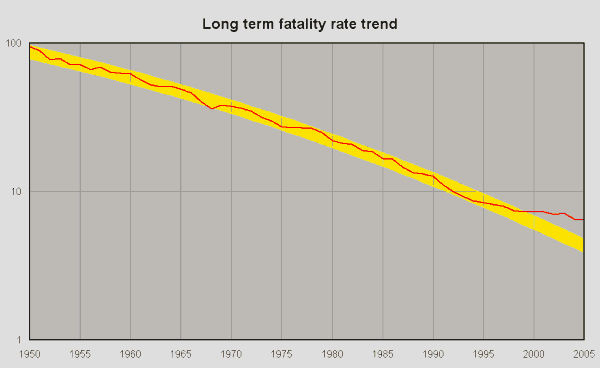
Speed cameras have failed as a road safety policy. Neither road deaths nor hospitalisations have fallen as expected. Resources being poured into speed cameras and associated policies at every level of our road safety system are wasted, and should have been put to far better use. We need to get rid of speed cameras to refocus those valuable life saving resources where they can actually save lives, not simply make matters worse. But speed cameras don't just waste resources. They come with a wide range of damaging side effects. You can download our side effects report. The net effect of all this has been a deadly loss of trend in road risk values. We first observed this in 2002. (click) Here's the latest graph:
The vertical scale is road deaths per million vehicle kilometres. The red line is actual data from Department for Transport. The yellow bar is a 'least squares fit' on the curve from 1950 until 1994 with the width of the bar representing 95% confidence intervals. It is one of dozens of fits that we have applied to the data and gives a middling estimate of the loss of trend. The deviation starts in about 1994 and coincides precisely with a change in road safety policy. The loss of trend is massive. and accounts for about one third of current road deaths. If the former trend had continued, national road deaths would be under 2,000 per annum by now. This is plain fact, not an idea for debate or interpretation. The difference between the former trend and actual results has been termed 'the fatality gap'. It's approaching 10,000 accumulated road deaths. The closest to an official explanation comes in TRL report 629 which concludes that 'some drivers must be getting worse'. Well, OF COURSE drivers, on average, are getting worse. We're giving them false safety information and we're not policing the roads properly. Speed cameras are responsible for both. This is a case of the cure being far worse than the disease. And when the cure is as bad as this, there's only one option. It has to go. We're NOT claiming that the correlation between speed camera policy and the loss of trend is proof of causation. The correlation merely adds to the body of evidence. |
| News and events
Press releases:
28th June: 2006 road deaths figures released at about 10am 29th June: ECHR 'right to silence'
verdict declares at 8:30am
Check back regularly for updates! Much more to come. |
| Communicating
Contact:
Further contacts to follow. |
Let's make speed cameras as unacceptable as drink driving
|
|
Copyright
© SafeSpeed 2007
Created 08/06/2007. Last update 28/06/2007 |