http://www.walesonline.co.uk/news/wales ... -23422489/http://www.timesonline.co.uk/tol/drivin ... 128614.eceTimes wrote:
From The TimesApril 20, 2009
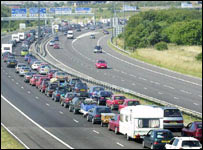
Busy roads, slower speeds, extra taxes – but we'll carry on driving
Two children help their parents wash the family car. March 1953
Ben Webster, Transport Correspondent
Britain is more dependent than ever on cars, according to a study published today. Even the poorest families are increasingly reliant on them, and when motoring costs rise they prefer to sacrifice other household spending rather than stop driving.
The number of cars has grown seven times faster than the population. There are 29.6 million cars, up 30 per cent from a decade ago. Over the same period the population has grown by 4 per cent to 60.6 million.
The RAC Foundation commissioned a team of academics from Oxford University, Imperial College and University College London to investigate how reliant Britons were on their cars. They found that people opted for them even for journeys that could easily be walked or cycled and were used for 78 per cent of journeys of two to three miles. Just over three quarters of homes had a car and ownership had grown fastest among the poorest fifth of households, up from 35 per cent in 2000 to 49 per cent in 2006.
The foundation said that government policies purporting to reduce car use — such as raising fuel duty and road tax — could increase social exclusion by penalising poor families. The researchers found a significant fall in the number of homes within easy walking distance of a grocer or chemist.
Related Links
COMMENT: 'I can't see being without my car'
Green car plans are stalled over subsidy snag
In addition to analysing Department for Transport data, the team gathered evidence from focus groups and found scepticism about the potential for replacing car trips with public transport. One 75-year-old participant said: “You can get to town [by bus] all right, but Sainsbury’s is a mile and a half that way, Tesco’s is a mile and half the other way. There’s no supermarket in the centre of town.”
The team detected the beginning of a generational divide in attitudes to car travel, with growing use among the over-70s but falling use among those aged 16 to 29. However, the fall in young people’s car use was partly due to their taking longer to obtain driving licences. Once qualified, they become as reliant on cars as older generations.
The average distance travelled by car per person has stabilised in recent years despite the big increase in ownership. The average car travelled 152 miles a week in 1996 but only 132 miles in 2006. The report said that congestion had caused average speed of trips to fall from 25.7 miles per hour in 1995 to 24.6mph in 2006, possibly discouraging people from making more journeys. However, many drivers preferred to queue in their cars even when they knew that public transport would be quicker. The report quoted a recent Department for Transport study that concluded: “Sitting in congested traffic conditions was seen as being more comfortable than waiting for a train or bus and drivers felt more in control. Drivers also saw the benefits of time alone, safety and independence.”
Women are slightly more dependent on cars than men, using them for about 77 per cent of the total distance they travel, compared with 74 per cent for men.
Professor Stephen Glaister, the foundation’s director, said: “More than four out of five people say they would find it difficult to use their cars less. It is a myth to claim public transport is the magic answer. The Government’s emphasis on high-speed rail ignores the reality of most people’s lives.
“The car is the bedrock of our society and our economy. It has democratised this country. There is no question of getting rid of cars. Instead we must change the type of cars we use — smaller, lighter, more fuel-efficient models with less CO2 emissions.”
He said it would be fairer to tax people for the number of miles they travelled than for owning a car. “The Chancellor should shift emphasis away from taxing people on what they own to what they use. This is likely to be through national road pricing. The trade-off for drivers would be the abolition of road tax and fuel duty, and more spending on the road network
The final sentence would see him to be a deranged fool - given the resounding NO from Manchester and Edinburgh as neither scheme promises any such trade-off .. just more costs to all so how they darned well travelled


 Login
 Register
 FAQ
 Search
 Members