I have receive this query and it is of further discussion.
Young Driver wrote:
I am a 20 year old driver, and am becoming increasingly worried/paranoid about my safety on the roads, specifically with regards to the vehicle that I drive.
I drive a 1996/7 R registration Peugeot 106 XN, with a 1.1L engine.
I was wondering if you could offer any information on the safety aspects of this car. How safe is it? Statistically, how does it look? How it could be improved, if necessary. Should I even be driving it, or should I perhaps get a newer car that has been manufactured according to the latest safety regulation?
I don’t believe my car has airbags, and this worries me, as although I am not fully informed as to the effectiveness of these in the first place.
Insurance companies will have more info about specific cars and accident stats, but there is nothing safer than a good well trained motorist, that is travelling carefully, applying many good 'behaviour's' than can aid in one's own safety every mile that you travel.
I am not able to advise you on any specific vehicle and it's relevant safety but Companies such as the AA will do a 'health check' on cars when considering purchase (may do after purchases?) or any good garage.
Airbags can help in accidents but if you do not have them learning and understanding how to drive well will help you not get into the accident (if you ever have happen to become involved in one), in the first place - hence defensive driving.
Good driving can keep a motorist safe from danger but it can take time to increase your abilities, knowledge and skills. There are many aspects to this and I am sure several of the Safe Speed members would like to contribute.
In principal there are good driving methods and skills that help each motorist to drive safely and each trip is way to learn something new and so gain knowledge and improve one's abilities.
There are places to go and learn more specifically - the Institute of Advanced Motorists is one such group and looking for those that teach 'Defensive Driving' techniques is another.
Principals like COAST - Concentration, Consideration, Courtesy, Observation, Anticipation, Awareness, Attitude, Space (your safety space all about you) and Two second rule, Time for journey & Time to react.
------
Then there is the Safe Speed 100 Word Motorists Highway Code :
Drive on the left. Make sure you can see and be seen. Keep a constant look out all around. Be aware of signs and regulations and why they are there. Be predictable.
Recognise and anticipate danger and keep clear space from it. Always ensure that you can stop within the distance that you know is clear. Develop your skills.
Give courtesy, co-operation and space to others. Don't obstruct them.
Never take risks, drive unfit or compete with others.
Safety is paramount and far more important than priority. Take personal responsibility for your safety and the safety of those nearby.
Enjoy.
copyright Safe Speed 2009 2010 -
http://www.safespeed.org.uk------
The Safe Speed 100 Word Motorists Highway Code maybe reprinted as long as the copyright and website are retained in all the visible message as a whole.

 Login
 Register
 FAQ
 Search
 Members


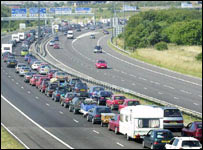
 (and I might even believe it if free traffic speeds now were lower)!
