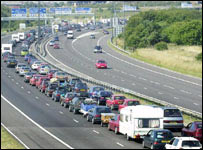
I believe the charge against the 150mph biker is for dangerous driving, not speeding. Let me recap some thoughts on the "dangerous driving" part of the case.
I believe I can prove there is no evidence to show the driving/riding was dangerous.
Logically, if the biker looks slow for 150mph, then the distances involved are inherently also greater than it looks. We know the camera has one heck of a telephoto setup (400mm sitting on a 6x crop factor imager – all this detail is in the current manuals). That setup has about 50x skew of perspective compared to what the human eye sees.
This little sign doesn’t look like it is 945m away from the gun in the video, but it really is.
I have shown the distance from the biker to the leading traffic to be ~200m in this post:
viewtopic.php?p=222188#p222188The same process that shows the speed to be 150mph will inherently show the distance to the leading vehicle to be 200m (at the time of the end of speed reading [will be greater if distance is at the midpoint of the speed reading]).
The large gaps, coupled with know deceleration rates of these bikes at high speed, supported by the fact the biker hardly had to apply the brakes (the brakes were applied for only ~1.1 seconds of the 5 seconds from the ping to the end of the video clip), shows the biker had the situation well under control.
I have shown how the riding in this case wasn’t dangerous, within
a Pistonheads thread:
Some relevant snippets from that thread are summarised below:
>>>>>>>>>>>>
At the time of the end of the speed reading, the van in L3 is 22 lane markers ahead of the biker, which is 198m.
Assuming the van is at a legitimate speed (70mph), the biker would have to scrub off the 150 – 70 = 80mph DIFFERENTIAL within that 198m gap between them.
Assuming a linear rate of deceleration, the biker would have to slow at an average rate of:
a=VV/2d = ( 80/(3600/1609.3))^2 / (2 * 198) * (3600/1609.3) = 7.2mph per second.
This translates to 11 seconds of braking at 7.2mph per second before catching (and not colliding with) the leading vehicle. This is a gentle rate of deceleration.
>>>>>>>>>>>>>
The aerodynamic drag (drag to inertia ratio) yields a significant amount of deceleration at 150mph type speeds, approaching 85kw of ‘slowing power’ acting on 300KG (wet weight and rider).
Including transmission losses, but not engine losses, that equates to:
85kW / (70.6m/s * 300KG) = 4.0m/s @ 158mph, translating to about:
(150/158)^2 * 4.0 * (3600/1609.3) = 8mph/sec at 150mph.
This drag means the biker can slow down at a much greater rate than the standard low-speed stopping distance guides state, because that drag force presents no load on the tyres or the brakes; the deceleration from those factors are additional.
Thus at the higher speeds (up to the 150mph), the biker will already slow at the rate needed to avoid collision, even without consideration of engine losses, or application of the brakes.
When considering engine losses and the fact the biker also braked, the resultant deceleration will far exceed that needed to avoid a collision with the leading vehicle.
>>>>>>>>>>>>
Considering the worst-case scenario of the van braking hard from 70mph (reasonable considering it was passing traffic shown to be doing 55mph) with the biker doing 150mph 200m behind, the total stopping distance available to the biker would have been:
200 + [(31.3)^2 / (2*9.80665*0.67)] + [0 (thinking time doesn’t apply)] = 200 +75 + 0 = 275m.
Assuming standard forces for an old car with drum brakes as per Highway Code (2/3 G, 2/3 sec; I don’t know the typical braking performance figures for these sports bikes):
[(67.05)^2 / (2*9.80665*0.67)] + [67.05 * 0.67] = 342 + 45 = 387m
However, we know the drag effect at those high speeds will add 8mph per second to the deceleration (for free as drag doesn’t present additional load on the tyres or brakes), which equates to an additional 0.36G (at 150mph).
Also, a biker doesn’t have to move a foot from one pedal to another to brake (and will likely be very ready to react in that situation)
Assuming 1G, 0.5 secs and 150mph = 262m. This is within the distance needed to avoid the van even if the van driver braked hard.
>>>>>>>>>>
The gap to the leading van was about 200m. However, the van itself was moving and the biker could see there was nothing in front of it (the lane the van changed into was clear of other traffic), so the biker can reason that it won’t suddenly turn into a static brick wall. Hence by the time the biker had reached that 200m point some 3.52 seconds later, if the van doing 70 it would have been a further 110m down the road, so reasonably extending the safe stopping distance.
Attachment:
 gap2.gif [487.2 KiB]
Downloaded 973 times
gap2.gif [487.2 KiB]
Downloaded 973 times
The bike covering 200m in those 3.52 seconds means it was doing an average speed of about 126mph over those three seconds. At the start of those 3 seconds, if the biker was doing the 150mph, at the end of that duration the biker would very likely have been doing 2 x 126 – 150 = 102mph (assuming a linear rate of deceleration, which is quite possible if the biker was gearing down when appropriate such that the engine braking would be greater, thus offsetting the reduction of the drag effect).
This rate of change of speed (48mph in 3.52 seconds = 13.6mph per second = 0.62G) is in keeping with the expected deceleration (drag, brief braking and engine losses).
The biker need scrub off a differential of 102 - 70 = 32mph in that 110m gap (assuming the van was doing 70).
Assuming a linear rate of deceleration: to prevent a collision, the biker would have to slow at an average rate of:
a=VV/2d = (32/(3600/1609.3))^2 / (2 * 110) * (3600/1609.3) = 2.1mph per second. This is trivial and easily within the bounds of aerodynamic drag and engine losses.
Again considering the worst-case scenario of the van braking hard from 70mph with the biker doing 102mph 110m behind, the total stopping distance available to the biker would have been:
110 + [(31.3)^2 / (2*9.80665*0.67)] + [0 (thinking time doesn’t apply)] = 110 +75 + 0 = 185m.
Assuming standard forces for an old car with drum brakes as per Highway Code, but with the faster reaction time (as before):
[(45.6)^2 / (2*9.80665*0.67)] + [45.6 * 0.50] = 181m.
Again, this is within the distance needed to avoid the van even if the van driver braked hard.
Additionally:
- the van driver is unlikely to have pulled out into lane 1 if there was traffic close behind.
- the biker would not have sat up (14:30:00NR32) if he was going faster than he thought safe to do so.

 Login
Login Register
 FAQ
FAQ Search
 Members


 ).
).