Safe Speed issued the following PR at 9:33 this morning:
PR239: Laser speed meters untrustworthy
News: For immediate release
BBC TV programme "Inside Out" have been testing a laser speed meter, and will
broadcast this evening a film showing two laser speed meters pointing at the
same vehicle showing markedly different speeds. The regional programme will air
in London and BBC South West region this evening at 7:30.
Under UK law, offences must be proven 'beyond a reasonable doubt'. The BBC film
illustrates a potentially commonplace error. Millions of drivers have been
convicted with unsound evidence, and many prosecutions are ongoing.
The error in question is known as 'slip error'. It happens when the aiming
point of the beam moves across the target vehicle. This works because laser
speed meters do not directly measure speed. Instead they take a series of
distance measurements. If the aiming point moves along the target vehicle the
change in distance of the aiming point adds to or subtracts from the true speed.
Sources tell us that the Home Office did not test for this error before issuing
type approval.
Paul Smith, founder of the Safe Speed road safety campaign
(
www.safespeed.org.uk) said: "I have seen the film and it is shocking. No
wonder we get a steady stream of indignant motorists complaining to us that
they know for sure that they were not driving at the speed of which they are
accused. And no wonder that people have christened the most common laser speed
meter the 'dodgyscope'.
Paul continues: "I am 100% certain that these devices are not suitable for
gathering legal evidence of vehicle speeds. They make mistakes and the BBC
film proves it. The Home Office must immediately suspend type approval on
these devices pending a full investigation. Millions of drivers will be
entitled to refunds, licence points removed and in some cases a large amount of
compensation."
At a very rough estimate, over 5 million drivers have been convicted on the
basis of laser speed meter evidence in the last 5 years. The fines refund alone
will run to £300 million. This is a disaster of epic proportions."
"Paul concludes: "With £300 million pounds at stake, we should expect some
fierce resistance. But resistance is futile. The 'dodgyscope' is proved to be
dodgy.
<ends>
Notes for editors
=================
Thumbnail image attached.
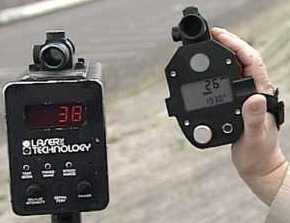
Higher res version (1600*1200):
http://www.safespeed.org.uk/pr239.jpg
Complete BBC PR:
================
'Slipping' speed guns may result in innocent South West drivers being fined
Strictly embargoed until 09.00 12/9/05
Claims that a hand-held speed gun - used by Police and Camera Safety
Partnerships across Devon and Cornwall - can give an inaccurate reading by
'slipping' are made by BBC South West's Inside Out programme tonight at 7.30pm
on BBC ONE.
The 'slipping' effect is caused when the gun's infra-red pulses are disrupted
by the operator moving the beam down the side of the vehicle instead of keeping
it steady. When this happens the gun can be effectively tricked, interpreting
the movement of the beam as speed, and the length of the car is added to the
distance actually travelled.
With the LTi 20-20 speed gun being used across Devon and Cornwall this could
lead to South West motorists receiving unfair fines.
In tonight's programme Dr Michael Clark, independent consultant to the traffic
and communications industries, commenting on the effect of a potential
'slipping' error, says: "If someone’s doing just below 70 mph on a motorway
that puts him up in the 90’s and they’re going to be done by the police for
sure."
Professor of engineering and author John Brignell believes that for an
operator, pointing the gun at a car 500 meters away, the movement needed to
slip off the number plate and down the side of a vehicle is minute. He says:
"Very roughly, without doing any calculations, we are talking about the camera
moving about the thickness of a human hair."
And even in an experiment carried out by Inside Out presenter Samantha Smith,
pointing the gun along the side of a stationary car, the device registered a
speed of six mph. When the test was then carried out on a truck travelling at
about 30 mph, a false result was obtained 7 out of 22 times. Wrong speeds of up
to 56 mph were displayed by the gun.
Teletraffic, the importers of the UK approved LTi 20-20 speed camera, claim it
is impossible to register a false reading from a moving target. The company
adapts the American LTi 20-20 guns to follow British specifications.
Presenter Sam Smith says: "Unfortunately Teletraffic, the Police and the Home
Office declined to take part in the programme which meant we were unable to
obtain a British version of the LTi 20-20 for our experiments, so Dr Clark
simply proved such misreadings can happen with the American speed gun too."
The Association of Chief Police Officers claim the experiment was 'misleading'
as the UK approved speed gun uses different 'error-trapping' software.
Yet a report, obtained by Inside Out and written by Frank Garratt, Managing
Director of Teletraffic, strongly suggests both versions of the LTi 20-20 are
the same. His report says the gun used by British Police is identical to the
version used by NASA. And NASA then told Inside Out that the version they use
is the American version. All of which seems to suggest that the UK and American
speed guns are identical.
Using the Freedom of Information Act the Inside Out investigation has also
discovered that the Home Office does not test for the 'slip effect' as part of
the approval process for these devices.
Inside Out: Monday 12th September, 7.30pm on BBC ONE
Note to Editor:
The LTi 20-20 speed gun is used by the Police and Camera Safety Partnerships
across the UK.
For further information contact:
[removed]
<end of BBC PR>

 Login
Login Register
 FAQ
FAQ Search
 Members


 Damn shame.
 - used to confirm a professional opinion that person is way over the limit.


