21st
May 2003
Dr Susan
Sharland
TRL
Limited
Old
Wokingham Road
Crowthorne
Berkshire
RG45
6AU
United
Kingdom
Dear
Dr Sharland
Speed
and Accidents
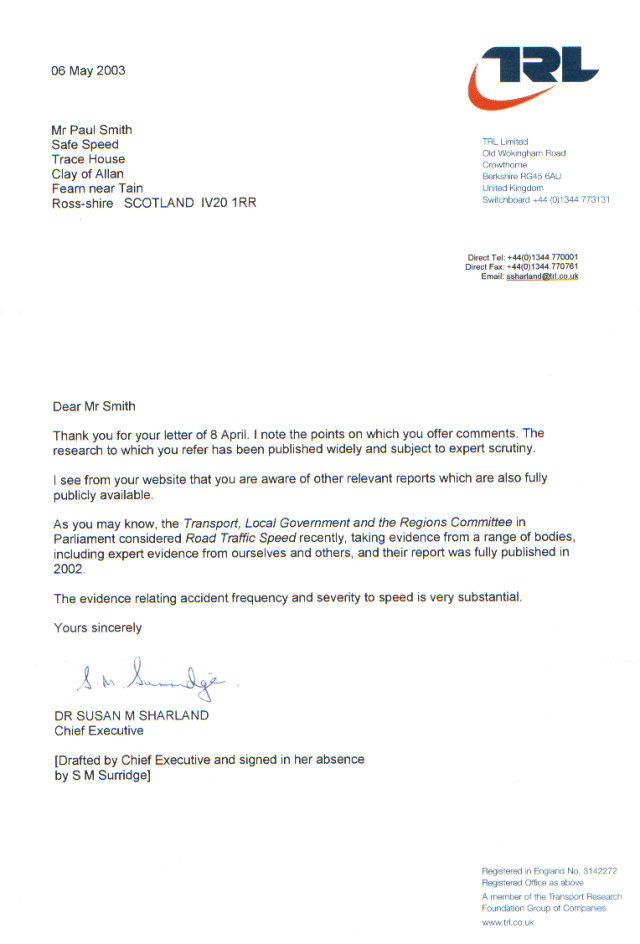
I refer
to my previous letters and your reply dated 16th May.
We
are finding it difficult to make any progress and this will be my last
letter to you on the subject. Please afford me the courtesy of answering
the following points individually and specifically.
1.
In your last letter, you refer to “the evidence relating speed to accident
frequency”, Can you give me any reference to any work that establishes
speed in excess of a speed limit as being causally related to accident
frequency?
2.
Can you give me any reference to research into speed and accidents where
causes in common have been eliminated in order to determine the relationship
between speed and accidents for normal drivers exceeding a speed limit?
(In particular it is important to eliminate the obvious potential distortions
caused by: speeding drunks, speeding escaping criminals, speeding joyriders
in stolen cars etc, where the cause of the speed and the cause of the accidents
may be the same, but are not causal linked, and cannot be usefully applied
to “normal motorists”.)
3.
Can you give me any reference to research where the link between speed
and driver concentration has been explored? In particular I am very concerned
that increased speed enforcement on motorways would reduce concentration
and lead to increases in sleep related accidents. It is also quite probable
that there would be an increase in inattention accidents.
4.
Can you give me any reference to research where the proportion of inappropriate
speed accidents above and below the speed limit has been investigated?
There is some Canadian research in this area which appears to indicate
that two thirds of inappropriate speed accidents take place within the
prevailing speed limit. If that research can be properly applied to the
UK, then there are some figures being widely quoted which need to be reduced
by 67%.
5.
Can you give me any reference to research where the negative effects of
increased speed enforcement have been explored? I am particularly concerned
about impacts on “drivers’ priorities” where at a critical instant
they might be more concerned about compliance with a legal speed limit
instead of an unseen dangerous situation developing ahead. Other important
negative factors include: Risk compensation: Where a driver at a
lower speed may unknowingly preserve risk values by driving closer or more
aggressively. Attitude effects: Where increasing the restrictions
on a driver may make him care less about his driving in general. Traffic
displacement: where an increase in speed enforcement on one route causes
drivers to chose an alternative route which is more dangerous.
6.
Can you give any explanation for the loss of trend in the UK fatal accident
rate? We have enjoyed a long-term beneficial history showing an average
5% per annum reduction, but in the last decade it has stalled and is likely
to show a real increase for the first time in modern history when the 2002
figures are announced in a few weeks’ time.
7.
Have you got any idea why the UK roads are just about the safest in the
World? I suggest that it is largely a “Hendon halo” where the techniques
and attitudes from the Police Driver Training Establishment at Hendon have
pervaded all aspects of UK driving culture via official recommendations,
legislation and the driving test. Whatever the cause(s), we would clearly
be extremely unwise to turn our backs on the principles which have made
our roads the safest in the World, but that is exactly what we are doing.
8.
Will you make any comment at all about the claim in TRL421 which started
this correspondence? The silence has been deafening. I pointed out that
it was neither fact nor science to claim a potential reduction in accidents
on the basis of the reported speed/accident relationship unless causality
was also established.
9.
And finally, have you ever involved highly trained drivers when setting
research objectives? You might be surprised and enlightened by the perspectives
that they have to offer.
I have
published our previous correspondence to the Internet at:
http://www.safespeed.org.uk/trl.html
[this
page]
I look
forward to hearing from you in due course.
Yours
sincerely
Paul
Smith |