Safe Speed Forums

The campaign for genuine road safety
It is currently Wed Oct 28, 2026 23:46

All times are UTC [ DST ]


Post new topic Reply to topic  [ 125 posts ]  Go to page Previous  1, 2, 3, 4, 5, 6, 7  Next
Author Message
 Post subject:
PostPosted: Mon Feb 14, 2005 18:05 
Offline
Banned
Banned

Joined: Thu Apr 15, 2004 12:47
Posts: 2291
bmwk12 wrote:
The Sun 8-) is no differant.


It bloody well is different to the rest - I live on a planet that orbits it!

_________________
I stole this .sig


Top
 Profile  
 
 Post subject:
PostPosted: Mon Feb 14, 2005 18:09 
Offline
Suspended
Suspended

Joined: Sat Apr 17, 2004 13:41
Posts: 539
Location: Herts
Quote:
It bloody well is different to the rest - I live on a planet that orbits it!


Just because you are here, it will not prevent it's natural cycle :!:

_________________
Steve


Top
 Profile Send private message  
 
 Post subject:
PostPosted: Mon Feb 14, 2005 18:09 
Offline
Banned
Banned

Joined: Thu Apr 15, 2004 12:47
Posts: 2291
bmwk12 wrote:
You can want, Nature will decide how habitable it will be.


Have you stopped your motor runing long enough to consider how thin the atmosphere that you depend on is - if the world was the size of a snooker ball, thr air would be as thick as a finger print. We need to STOP this pollution before it STOPS us!

_________________
I stole this .sig


Top
 Profile  
 
 Post subject:
PostPosted: Mon Feb 14, 2005 18:10 
Offline
Suspended
Suspended

Joined: Sat Apr 17, 2004 13:41
Posts: 539
Location: Herts
Quote:
Careful with that mate, I did that, then my wife left me and it cost me £450 to insure a £100 Volvo. Bugger


If my wife left me, i would save far more than £450.00 :lol:

_________________
Steve


Top
 Profile Send private message  
 
 Post subject:
PostPosted: Mon Feb 14, 2005 18:10 
Offline
Banned
Banned

Joined: Thu Apr 15, 2004 12:47
Posts: 2291
bmwk12 wrote:
Quote:
It bloody well is different to the rest - I live on a planet that orbits it!


Just because you are here, it will not prevent it's natural cycle :!:


I like its natural cycle. It's oil companies and cars that are the trouble.

_________________
I stole this .sig


Top
 Profile  
 
 Post subject:
PostPosted: Mon Feb 14, 2005 18:16 
Offline
Suspended
Suspended

Joined: Sat Apr 17, 2004 13:41
Posts: 539
Location: Herts
Quote:
I like its natural cycle.


Based on History, we should be heading to be submerged, better buy a boat :!:

Quote:
It's oil companies


That supports the world's economy :!:


Quote:
cars that are the trouble.


Regular servicing, takes care of that :lol:

_________________
Steve


Top
 Profile Send private message  
 
 Post subject:
PostPosted: Mon Feb 14, 2005 18:38 
Offline
Gold Member
Gold Member

Joined: Mon Mar 15, 2004 15:43
Posts: 2416
basingwerk wrote:
Gatsobait wrote:
basingwerk wrote:
Human hydrocarbon consumption has raised the C02 ppm count 20% in our lives!
I can't find anywhere that says it's even gone up by that much in such a short time, let alone due solely to hydrocarbon usage. 20% across the whole industrial age, maybe, but even then 6/7th of that is natural.
Check it out on observation at Mauna Loa
And where does it say that rise is entirely anthropogenic? Nowhere. It does mention vulcansim as a source, which is ironic given where the measurements are taken from. Gotta love the surpressed zero and clever scaling as well.

basingwerk wrote:
The climate is a system with lots of variables and a few important ones. C02 is an important one, and can be used to change and/or control the system.
No, it is not an important variable. It runs a distant second to water vapour, both in terms of volume and strength, and that's just talking about greenhouse gases.

basingwerk wrote:
Gatsobait wrote:
Nature has shown itself to be capable of that sort of increase without human intervention.

The levels of C02 are unknown in human history and I am not aware that nature has shown itself capable, in human history, of adjusting to a 20% rise, let alone a much bigger one.
They have not been directly measured but proxies exist.

basingwerk wrote:
<snip> and the sea will rise if the WAIS breaks up.
You mean when it breaks up, not if. Ice-shelves always break up. They do it because they're ice shelves, subject to wave action and being pushed forward into warmer waters. It'd be a pretty weird world if ice-shelves didn't fall to bits periodically. Where else would the icebergs in the Southern Ocean come from? They ain't drifting down from the north. And calving ice shelves don't change the sea level because they're already floating on it and displacing water equal to their mass (except where they're supported at the edge of the land of course).

basingwerk wrote:
I'm talking about carbon and oxygen - the most basic parameters of all. Please explain what other variables are more important than carbon - are there really any?
For living they're pretty important, but for climate there are far more important factors. Solar output, distance from the sun, axial tilt - c'mon, you're a rocket scientist! What would happen if you turn the sun up or down by even 0.1%, or shift apogee one way or the other by a million miles? I've already mentioned water vapour, which has a much stronger greenhouse effect than CO2. Without the greenhouse effect of water vapour the planet would be far colder, perhaps even too cold to support the variety of life we see now. I don't know for sure but I don't recall oxygen even getting a mention in regards to climate, except as O3 of course.

basingwerk wrote:
Gatsobait wrote:
Quote:
In climate research and modelling, we should recognize that we are dealing with a coupled non-linear chaotic system, and therefore that the prediction of a specific future climate state is not possible.

That being the case (as it may be) I'd like to leave things like they were, i.e. in the steady state of last centuries. That may not be possible, alas.
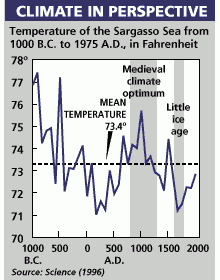
Look, for the last time, there has been no steady state. There has not even been a steady state of the last few centuries. We've gone from temperatures at least as high as today's, if not noticeably warmer, in medieval times, through a period of cooling often called the Little Ice Age (about mid C15th to mid C18th), after which it went up for a bit and then down again for the turn of the century. Even on a very short scale of a few decades it's not steady. The 1690s saw the beginning of a big jump in temperature, about twice that of C20th and in less than half the time. Probably a bit of a relief for everyone as it was cold as a witch's wossname round then. And I'm sure you'll remember the imminent ice age predictions of the 70s caused by a few unseasonably cold winters.

And if you don't mind going back further, there's this reconstruction from the Sargasso Sea (Keigwin 1996).
Image
Hands up, there's a suppressed zero and some scaling going on there too, but you get the picture. There hasn't been stability even in historical timescales, never mind geological. Nor is there anything unprecedented about current tempratures or rate of increase.

_________________
Make everything as simple as possible, but not simpler - Einstein


Top
 Profile Send private message  
 
 Post subject:
PostPosted: Mon Feb 14, 2005 18:48 
Offline
Gold Member
Gold Member

Joined: Mon Mar 15, 2004 15:43
Posts: 2416
basingwerk wrote:
...for thousands of years, it hasn't done far worse things to the climate than our cars and industry are doing now.
Best you let the BBC know. They've had this page up for ages saying that climate change nearly wiped us out 100,000 years or so ago. If they're wrong about that I'm sure they'd like to be corrected.

_________________
Make everything as simple as possible, but not simpler - Einstein


Top
 Profile Send private message  
 
 Post subject:
PostPosted: Mon Feb 14, 2005 18:52 
Offline
Suspended
Suspended

Joined: Sat Apr 17, 2004 13:41
Posts: 539
Location: Herts
Agree with your replies

Quote:
And calving ice shelves don't change the sea level because they're already floating on it and displacing water equal to their mass (except where they're supported at the edge of the land of course).


What the Climate brigade, also seem to miss, is where the water came from in the 1st place to create the ice shelve.

_________________
Steve


Top
 Profile Send private message  
 
 Post subject:
PostPosted: Tue Feb 15, 2005 10:18 
Offline
Banned
Banned

Joined: Thu Apr 15, 2004 12:47
Posts: 2291
Gatsobait wrote:
And where does it say that rise is entirely anthropogenic? Nowhere.


If it is anthropogenic, we can cut back and survive, perhaps. If it is not, we're screwed. Let's be positive! You strain my credulity if you expect me to believe that you don't suspect that a very large part of the 40% increase since the industrial revolution has been caused by the industrial revolution - have you seen a blast furnace open up?

Gatsobait wrote:
No (C02) is not an important variable. It runs a distant second to water vapour, both in terms of volume and strength, and that's just talking about greenhouse gases.


Water vapour is emitted by cars as well as C02! Are you arguing with me, or for me! Just pulling your leg. Water vapour is rapidly assimilated by the sea, but C02 takes 100's years, and in any case adds to ocean acidity.

basingwerk wrote:
<snip> and the sea will rise if the WAIS breaks up.
You mean when it breaks up, not if. [/quote]

It is important if a net change occurs, rather than a continuum. If the WAIS breaks up, it will be a net change, and the water will rise. The WAIS, if I recall correctly, is resting on Antarctica. Similar concerns exist for Greenland.

basingwerk wrote:
Solar output, distance from the sun, axial tilt - c'mon, you're a rocket scientist! What would happen if you turn the sun up or down by even 0.1%, or shift apogee one way or the other by a million miles?


I haven’t made a burn plan in 10 years! Apogee/perigee/eccentricity/inclination/semi major axis could all have effects, but the delta-v required could only be delivered by a huge burn or impact, so it is out of the frame, I reckon. The sun does burn steadily enough to support us as we are now. The system of climate does not appear to be totally open-loop - it's behaviour over very short periods (e.g. 80 generations from the time of Christ until now) suggests that it is operating within bounds and that sea levels in particular have been quite constant – no 20 foot rises! We should exploit this period of stability, rather than ruin it.

basingwerk wrote:
Look, for the last time, there has been no steady state. There has not even been a steady state of the last few centuries. We've gone from temperatures at least as high as today's, if not noticeably warmer, in medieval times, through a period of cooling often called the Little Ice Age (about mid C15th to mid C18th), after which it went up for a bit and then down again for the turn of the century. Even on a very short scale of a few decades it's not steady. The 1690s saw the beginning of a big jump in temperature, about twice that of C20th and in less than half the time. Probably a bit of a relief for everyone as it was cold as a witch's wossname round then. And I'm sure you'll remember the imminent ice age predictions of the 70s caused by a few unseasonably cold winters.


The models which support climate change (which have been borne out over time) are not invalidated due to other things that effect the climate. Industrial gases have increased, the climate is changing, models exist to support the hypothesis that these are related and since models were devised, the reality has matched or exceeded their worst predictions.

Listen, Gatsobait, I would like to believe your optimistic view, and I am overwhelmed by your knowledge of the issue. You have done your homework. But you just don’t [b]get[/i] the magnitude of the C02 issue. Wars have already been fought about it, 100,000s have already died in Africa to support our industry, air travel, air conditioning and cars. It is only when Europeans are eating rats in cellars that the message will come home.

_________________
I stole this .sig


Top
 Profile  
 
 Post subject:
PostPosted: Tue Feb 15, 2005 15:54 
Offline
Gold Member
Gold Member

Joined: Mon Mar 15, 2004 15:43
Posts: 2416
Long reply, so I'll split it.

basingwerk wrote:
If it is anthropogenic, we can cut back and survive, perhaps. If it is not, we're screwed. Let's be positive!
Side issue: I'm glad you see that we may be screwed if it's natural. Doesn't that mean according to the precautionary principle we should be directing our efforts at adapting to natural changes? Or are you ditching the precautionary principle. Not a big deal, just curious.

basingwerk wrote:
You strain my credulity if you expect me to believe that you don't suspect that a very large part of the 40% increase since the industrial revolution has been caused by the industrial revolution - have you seen a blast furnace open up?
Only on TV, and no I don't think it's pretty. Nor am I saying it's emission free or that those emissions have no effect. The point is that natural sources dwarf anthropogenic ones and we cannot account for the rise by industry alone. In addition recent research shows that CO2 rises after temperature goes up, which could mean the rise is an effect of global warming, not a cause.

basingwerk wrote:
Water vapour is emitted by cars as well as C02! Are you arguing with me, or for me! Just pulling your leg. Water vapour is rapidly assimilated by the sea, but C02 takes 100's years, and in any case adds to ocean acidity.
I know H2O vapour is emitted by cars - I think I brought it up. But as rapidly as it's assimilated in one place it's being chucked out again somewhere else. I'd guess that happens a lot in tropical waters.


basingwerk wrote:
Gatsobait wrote:
basingwerk wrote:
<snip> and the sea will rise if the WAIS breaks up.
You mean when it breaks up, not if.
It is important if a net change occurs, rather than a continuum. If the WAIS breaks up, it will be a net change, and the water will rise. The WAIS, if I recall correctly, is resting on Antarctica. Similar concerns exist for Greenland.
Firstly, change is the continuum. Secondly, I'm afraid you don't recall correctly. Ice sheets sit on Antarctica's landmass. Ice shelves sit on the water along the edge of the land and in inlets. About 11% of Antarctica's "surface" is not land but ice shelves. Have a goosey:

Image

I'm not sure which one you mean by WAIS but I imagine it's Larsen, which is about the most westerly big shelf (running up the eastern edge of the Antarctic Peninsula) and treated TV crews a few years ago who got some spectacular footage of Larsen B calving in a big way. What wasn't mentioned much is that Larsen, like all ice shelves, is being affected by water movement, and unusually for the Antarctic is also outside the Antarctic circle. And of course icebergs aren't exactly a modern phenonomen anyway. The other possible WAIS is the Filchner-Ronne Ice Shelf (or possibly shelves). They're next-door neighbours in the southern Weddell Sea, together making a skating rink larger than California and up to 2000 feet thick. The whole shooting match floats on a piece of ocean over 4500 feet deep ocean, and is more or less held in place by the land around it and the islands within it. This makes it fairly stable, but of course one edge is largely unsupported (Berkner island sits between the northern edges of Ronne and Filchner) and faces into the Weddell Sea. Obviously the water action at face and underneath it damage its integrity and causes it to calve off bergs, just like Larsen B did. I'm not aware of how much the size of Filchner-Ronne has changed, but the similarly sized (well, a bit larger) Ross shelf is much the same as it was in 1902. Icebergs calve off shelves, but glaciers and sheets continue to feed them. I'd guess that coastal ice shelves can change more drastically than inlet types like Ross and Filchner-Ronne as they're not as well supported and narrower to begin with.

Ice sheets, such as the one on Greenland, are another matter. Melt that and there will be a change in sea level, and there's no denying it. There's also no denying that it might melt in the future, perhaps even in the next few centuries. After all, the Greenland ice sheet wasn't even there only 800 years ago (the Vikings there lasted till about 1400). I'm taking nothing for granted, but somehow we coped in the medieval period without ice on Greenland and presumably consequentially higher seas, and we had a fraction of our current resources and technology to deal with it.

Edited for typos and a glaring cock-up :oops: .

_________________
Make everything as simple as possible, but not simpler - Einstein


Last edited by Gatsobait on Tue Feb 15, 2005 16:26, edited 3 times in total.

Top
 Profile Send private message  
 
 Post subject:
PostPosted: Tue Feb 15, 2005 16:04 
Offline
Suspended
Suspended

Joined: Sat Apr 17, 2004 13:41
Posts: 539
Location: Herts
Quote:
We should exploit this period of stability, rather than ruin it.


Stability has only come since man started throwinmg emissions into the air :!:

So just maybe, you are looking at it from the wrong side :wink:

Quote:
The models which support climate change (which have been borne out over time) are not invalidated due to other things that effect the climate.


All prediction models, have proved wrong, their is not a prediction model that exist's, that has proved correct.

_________________
Steve


Top
 Profile Send private message  
 
 Post subject:
PostPosted: Tue Feb 15, 2005 16:09 
Offline
Gold Member
Gold Member

Joined: Mon Mar 15, 2004 15:43
Posts: 2416
basingwerk wrote:
I haven't made a burn plan in 10 years! Apogee/perigee/eccentricity/inclination/semi major axis could all have effects, but the delta-v required could only be delivered by a huge burn or impact, so it is out of the frame, I reckon.
No massive burn needed at all. It's well known that our orbit is subject to cycles that can cause huge variations - probably the last ice age was one, and we're still recovering from that (as well as the C18th Little Ice Age). Solar output varies on a number of cycles too, the shortest of which is the 11 year long sunspot cycle, and as that can be a year or so longer or shorter a direct natural variable can produce changes in less than a decade. All the cycles are of widely different lengths - between about decade and 40,000 odd years I think. Normally that'd mean just run of the mill variability, but I suppose there must be times when they all reach a peak or trough at the same time. That'd mean extra thick zinc all over or a 500tog duvet.

Other natural events can have a short-term effect as well. I think Krakatoa and Mount St. Helens both had widespread effects, didn't they? Then there's things like the Tunguska(sp?) event when something went bang in a big way in Siberia.

basingwerk wrote:
The models which support climate change (which have been borne out over time) are not invalidated due to other things that effect the climate.
They don't need to be when they are incapable of predicting observed changes. For heaven's sake, the bloody IPCC says they can't be relied upon! And on that point, haven't you noticed how the models that once gave "predictions" now give "scenarios". Hardly confidence inspiring. It goes without saying that the scariest scenarios tend to be in the newspapers, as reporting on a model that says nothing much is going to happen won't sell any extra copies.

basingwerk wrote:
Industrial gases have increased, the climate is changing, models exist to support the hypothesis that these are related and since models were devised, the reality has matched or exceeded their worst predictions.
The reality hasn't got remotely near their worst predictions (or projections or scenarios or whatever they call 'em next :wink: ), much less matched or exceeded it. The damned things struggle to predict the present unless someone points the computer out the fecking window so it can see what's going on outside. As for the gases have gone up, climate has changed bit, post hoc, ergo prompter hoc mate - unless of course the temperature rise went up first, in which case a time machine will be necessary to support even that.

basingwerk wrote:
Listen, Gatsobait, I would like to believe your optimistic view...
I wouldn't call natural climate change a cause for optimism. As you said earlier, it may well mean we are severely screwed. Though it may just mean a return to times of growing grapes in Northumberland as the medieval monks did. Who knows, the 2025 Barrow-in-Furness might be a particularly fine vintage (distinguished by its faint glow :lol: :lol: )

basingwerk wrote:
... you just don?t [b]get[/i] the magnitude of the C02 issue. Wars have already been fought about it, 100,000s have already died in Africa to support our industry, air travel, air conditioning and cars. It is only when Europeans are eating rats in cellars that the message will come home.
I didn't hear about a war over CO2. Which was that?

And as for rats appearing on European menus, haven't you seen that the EU is one of the AGW theories staunchest allies. It seems like the whole continent is up for it, and certainly in a political sense since just about everyone signed up for Kyoto right away. They've even managed to get the Russians on board after years of Moscow saying AGW is rubbish, though who knows? Perhaps the Russians have realised they can get a big cash boost for their economy with the carbon trading scheme. I'll be amazed if they're emitting at anything like 1990 levels, so they ought to be able to sell loads of credits to nations who don't have a cat in hell's chance of meeting their treaty commitments.

Edited for typos.

_________________
Make everything as simple as possible, but not simpler - Einstein


Top
 Profile Send private message  
 
 Post subject:
PostPosted: Tue Feb 15, 2005 17:57 
Offline
Banned
Banned

Joined: Thu Apr 15, 2004 12:47
Posts: 2291
Gatsobait wrote:
It's well known that our orbit is subject to cycles that can cause huge variations - probably the last ice age was one, and we're still recovering from that (as well as the C18th Little Ice Age).


Are you referring to nutation and precession perturbations? Precession has a phase of 27,000 odd years, and the poles of the orbit describe a cone in that period. I have never heard it said that it caused an ice-age. I think of Nutation, which has a period of 18.6 years, as a wobble on top of the precession, and again, it's effects are not cataclysmic in any sense at all.

Gatsobait wrote:
Solar output varies on a number of cycles too, the shortest of which is the 11 year long sunspot cycle, and as that can be a year or so longer or shorter a direct natural variable can produce changes in less than a decade.


Solar max happens every 11 years. One was in 1989, and another in 2000. It does have significant effects on solar radiation pressures on panels, which effects attitude and station keeping quite a bit. It can knock the orbit of a spacecraft around quite a lot, but again, it's climate effects are transient, not cataclysmic and not accumulative.

Gatsobait wrote:
Other natural events can have a short-term effect as well. I think Krakatoa and Mount St. Helens both had widespread effects, didn't they? Then there's things like the Tunguska(sp?) event when something went bang in a big way in Siberia.


You are starting to get up to the block now. Mount St. Helens is beginning to match up to the C02 problem, but is still transient in comparison. As far as I can recall, it may have affected the figures for a few years, but even that totally paled into insignificance against the backdrop of global industrial output after a year or two or certainly a decade.

Gatsobait wrote:
basingwerk wrote:
The models which support climate change (which have been borne out over time) are not invalidated due to other things that effect the climate.
They don't need to be when they are incapable of predicting observed changes. For heaven's sake, the bloody IPCC says they can't be relied upon! And on that point, haven't you noticed how the models that once gave "predictions" now give "scenarios". Hardly confidence inspiring.


It is rather difficult to inspire confidence when the outlook is dire even with the best cases of the “projections”, call them what you will.

Gatsobait wrote:
It goes without saying that the scariest scenarios tend to be in the newspapers, as reporting on a model that says nothing much is going to happen won't sell any extra copies.


Are there any model that says nothing much is going to happen?

Gatsobait wrote:
The reality hasn't got remotely near their worst predictions (or projections or scenarios or whatever they call 'em next :wink: )


Time was when we didn’t need air conditioners in this country! Anyway, let’s get back to the recent 40% rise – do you expect anyone to believe that this it not industrial output? What about the 20% rise in our lifetimes – have you brushed it under the carpet?

_________________
I stole this .sig


Top
 Profile  
 
 Post subject:
PostPosted: Tue Feb 15, 2005 18:18 
Offline
Suspended
Suspended

Joined: Sat Apr 17, 2004 13:41
Posts: 539
Location: Herts
Quote:
Time was when we didn’t need air conditioners in this country!


We did not have central heating either :!:

However air/con is now affordable, which is why more and more people have it. Had they had the cheap tecnology, we would of had it before.

Quote:
Anyway, let’s get back to the recent 40% rise –


Rise in what:?:

_________________
Steve


Top
 Profile Send private message  
 
 Post subject:
PostPosted: Tue Feb 15, 2005 21:04 
Offline
Gold Member
Gold Member

Joined: Mon Mar 15, 2004 15:43
Posts: 2416
Oh crap! I've edited this post instead of quoting from it and lost most of it. I'll have to rewrite it. :evil: :oops: :x

Edit: near as I can make thanks to basingwerk quoting the original, it went something like this:

basingwerk wrote:
Gatsobait wrote:
It's well known that our orbit is subject to cycles that can cause huge variations - probably the last ice age was one, and we're still recovering from that (as well as the C18th Little Ice Age).
Are you referring to nutation and precession perturbations? Precession has a phase of 27,000 odd years, and the poles of the orbit describe a cone in that period. I have never heard it said that it caused an ice-age. I think of Nutation, which has a period of 18.6 years, as a wobble on top of the precession, and again, it's effects are not cataclysmic in any sense at all.
Nope, well, not so much as 100,000 year eccentricity one, which is the monster for major changes. I take your word for the length of the precession cycle, though I read earlier that it was 23,000 years. I don't know if precession and nutation would cause an ice age by themselves, but remember that they will enormously effect where the suns energy lands, which in turn could change the surface albedo. Off the top of my head I imagine if they resulted in ice further south than we have at the moment more radiation will be reflected off the surface, which makes it colder, which brings more ice, which... feedback can work both ways you know. Has it happened and will it happen? Dunno, I need to read more.

basingwerk wrote:
Gatsobait wrote:
Solar output varies on a number of cycles too, the shortest of which is the 11 year long sunspot cycle, and as that can be a year or so longer or shorter a direct natural variable can produce changes in less than a decade.
Solar max happens every 11 years. One was in 1989, and another in 2000. It does have significant effects on solar radiation pressures on panels, which effects attitude and station keeping quite a bit. It can knock the orbit of a spacecraft around quite a lot, but again, it's climate effects are transient, not cataclysmic and not accumulative.
That's just the sunspot cycle, which itself is a component of a larger cycle. During the Little Ice Age the 11 year cycle took a few decades off IIRC (the Maunder Minimum). Of course it's no more true to say that particular correlation was also the causation than it is for CO2 and warming.

BTW, apologies for my misuse of terms earlier. I forgot we should be referring to aphelion and perihelion.

I've since read that there is another short term solar cycle of about 20 years and a more mid-term one of a couple of centuries. That reminded me of something on the BBC a while back about the sun currently being at it's most active for 1000 years. Perhaps this is the sun's version of that biorythms idea than was going round some years ago. Some times all three cycles will hit their maxima at the same time, or their minima for that matter.

basingwerk wrote:
Gatsobait wrote:
Other natural events can have a short-term effect as well. I think Krakatoa and Mount St. Helens both had widespread effects, didn't they? Then there's things like the Tunguska(sp?) event when something went bang in a big way in Siberia.
You are starting to get up to the block now. Mount St. Helens is beginning to match up to the C02 problem, but is still transient in comparison. As far as I can recall, it may have affected the figures for a few years, but even that totally paled into insignificance against the backdrop of global industrial output after a year or two or certainly a decade.
I did say short term effects, didn't I. Individually, yes, anthropogenic sources would soon have overtaken these natural ones. But don't forget that the natural ones have been going since year dot and will continue to do so.

basingwerk wrote:
Gatsobait wrote:
It goes without saying that the scariest scenarios tend to be in the newspapers, as reporting on a model that says nothing much is going to happen won't sell any extra copies.
Are there any model that says nothing much is going to happen?
I'll have to get back to you on that. I have certainly seen some that look pretty tame compared to the ones that get reported in the media.

basingwerk wrote:
Gatsobait wrote:
The reality hasn't got remotely near their worst predictions (or projections or scenarios or whatever they call 'em next )
Time was when we didn?t need air conditioners in this country!
Oh we needed 'em alright - we just didn?t have them. I reckon they'd have been handy in Roman times, the medieval period, and even the 1930s.

basingwerk wrote:
Anyway, let's get back to the recent 40% rise - do you expect anyone to believe that this it not industrial output? What about the 20% rise in our lifetimes - have you brushed it under the carpet?
No, it's still on the sofa. I need to do some more hunting for that. A lot of my bookmarks are dead links and stuff has moved elsewhere (that'll teach me to save interesting pages, but I'm such a tightwad with drive space, particularly when I've got so many big image files). However, I remind you that recent papers show CO2 rises after temperature increases, and that post-Little Ice Age a temperature rise was a virtual certainty. And what would that mean?
Quote:
Indy, they're digging in the wrong place.


_____________________________________________________________

Can't believe I've had to do that again. What a :oops: :P :shock: :twisted:

_________________
Make everything as simple as possible, but not simpler - Einstein


Last edited by Gatsobait on Wed Feb 16, 2005 15:40, edited 6 times in total.

Top
 Profile Send private message  
 
 Post subject:
PostPosted: Wed Feb 16, 2005 00:59 
Offline
Life Member
Life Member

Joined: Sat Mar 27, 2004 13:50
Posts: 2643
Just my tuppence worth...

The global warming theory has been around for over 100 years now but, until 25 years ago it was regarded as an inconsequential curiosity, because that's exactly what it is.
The physics are well understood, and the radiative forcing of a doubling of CO2 concentrations will lead to a global average temperature increase of in the order of one degree celsius. That much is agreed by pretty much every scientist. A one-degree warming will go pretty much unnoticed, seeing as we get far larger temperature swings between day and night, and still far larger swings between summer and winter.
But a one degree warming won't create media interest, and certainly won't generate research funding or finance supercomputers. So they need to make it bigger. Along comes water vapour to the rescue. Water vapour is a far more potent greenhouse gas than CO2, and there's a hell of a lot more of it in the atmosphere. So they concoct a theory that more CO2 = more heat = more evaporation from the oceans = more water vapour = still more heat. A nice little positive feedback loop.
Except that, in a feedback loop, you have an input node and a feedback loop. But water vapour, like CO2, is an input node, and in the order of a hundred times greater the level. So what they're saying is that 99% of the input simply amplifies the effect of the other 1% of the input?
And, as water vapour creates clouds which reflect incoming radiation, and which, through convection, vault great amounts of surface heat back out into the upper atmosphere to be dissipated back into space, it's far more likely that water vapour is a negative feedback mechanism. (more water vapour = more clouds = more reflection and convection = less heat)
This appears to be the case, as 1) as we're reckoned to have around 50% more CO2 now than in pre-industrial times, you'd expect that we'd by now have around 50% of the warming they've predicted - but we don't, and 2) as a good part of the globe has summer temperatures consistently higher than the global average, and we haven't seen any indications of thermal runaway.
The problem with the computer models is that they handle water vapour, and clouds in particular, very poorly - if at all. One can literally get better predictions from a random number generator.
And, because the 'worst' of the models predicts a six to ten degree rise in temperature, that's the one that gets all the media attention.
When they get the models to 1) agree with each other and 2) consistently and repeatably predict today's temperatures on the basis of known data from yesterday, perhaps I'll start believing them. But that's still a very long way off.

Regards
Peter


Top
 Profile Send private message  
 
 Post subject:
PostPosted: Wed Feb 16, 2005 10:41 
Offline
Banned
Banned

Joined: Thu Apr 15, 2004 12:47
Posts: 2291
Gatsobait wrote:
basingwerk wrote:
Are you referring to nutation and precession perturbations?
Nope, well, not so much as 100,000 year eccentricity one, which is the monster for major changes.


Don't know much about that one. As far as I know, the orbit is subject to Kepler's laws, although there will be perturbations and perhaps the eccentricity vector would evolve as you say. Please give me a source of information on that.

Gatsobait wrote:
I take your word for the length of the precession cycle, though I read earlier that it was 23,000 years. I don't know if precession and nutation would cause an ice age by themselves, but remember that they will enormously effect where the suns energy lands, which in turn could change the surface albedo. Off the top of my head I imagine if they resulted in ice further south than we have at the moment more radiation will be reflected off the surface, which makes it colder, which brings more ice, which... :twisted: feedback can work both ways you know. :twisted: Has it happened and will it happen? Dunno, I need to read more.


I’ve looked up precession and my source says 26K, so that’s the ballpark. Let me know what you find out on the other stuff.

Gatsobait wrote:
BTW, apologies for my misuse of terms earlier. I forgot we should be referring to aphelion and perihelion. :oops:


Spot on - apogee / perigee is fine for me, though they describe any orbit (including the earth around the sun), whereas aphelion and perihelion describe a more specific planetary orbit around the sun.

Gatsobait wrote:
basingwerk wrote:
Solar max ...
That's just the sunspot cycle, which itself is a component of a larger cycle. During the Little Ice Age the 11 year cycle took a few decades off IIRC (the Maunder Minimum). Of course it's no more true to say that particular correlation was also the causation than it is for CO2 and warming.


Again, we are talking about transient effects, not a constant accumulation over several decades, which trends above these other issues.


Gatsobait wrote:
basingwerk wrote:
even (St. Helens ) totally paled into insignificance against the backdrop of global industrial output after a year or two or certainly a decade.
I did say short term effects, didn't I. Individually, yes, anthropogenic sources would soon have overtaken these natural ones. But don't forget that the natural ones have been going since year dot and will continue to do so.


You have seen the C02 ppm graph, and you have seen how steady it climbs, on an annual basis, from the data at Mauna Loa. That is a famous graph- it steadily it climbs as industrial output increases.

Gatsobait wrote:
basingwerk wrote:
Are there any model that says nothing much is going to happen?
I'll have to get back to you on that. I have certainly seen some that look pretty tame compared to the ones that get reported in the media.


Yes, let's do that. Like I said, I want to believe you, but I am in a scientific milieu, and I keep my ears and eyes open for material on climate change, and I don't see the good news.

Gatsobait wrote:
basingwerk wrote:
Anyway, let’s get back to the recent 40% rise -
No, it's still on the sofa. I need to do some more hunting for that. A lot of my bookmarks are dead links and stuff has moved elsewhere (that'll teach me to save interesting pages, but I'm such a tightwad with drive space :) particularly when I've got so many big image files). However, I remind you that recent papers show CO2 rises after temperature increases, and that post-Little Ice Age a temperature rise was a virtual certainty. And what would that mean?
Quote:
Indy, they're digging in the wrong place.
:wink:


Indy now believes in saving the world - quote from Entertainment News:
Quote:
In partnership with Global Green USA, an affiliate of Green Cross International, several celebrities arrived at the Oscars in chauffeured Toyota Prius’s this past Sunday. Cameron Diaz, Harrison Ford, Susan Sarandon and Robin Williams agreed to the take part in the effort. The goal of the partnership, according to Matt Peterson of Global Green USA, was to show “that there are people who care about lessening our dependence on foreign oil and increased fuel efficiency.” Peterson went on to state that alternative fuel vehicles “are part of the solution to global warming, pollution and lowering our gas bills.”

_________________
I stole this .sig


Top
 Profile  
 
 Post subject:
PostPosted: Wed Feb 16, 2005 10:44 
Offline
Gold Member
Gold Member

Joined: Mon Mar 15, 2004 15:43
Posts: 2416
basingwerk - you star. You've saved most of my accidentally destroyed post :) .

Here's the bit I wanted to keep
Gatsobait wrote:
basingwerk wrote:
Anyway, let's get back to the recent 40% rise - do you expect anyone to believe that this it not industrial output? What about the 20% rise in our lifetimes - have you brushed it under the carpet?
No, it's still on the sofa. I need to do some more hunting for that.

To follow up on that basingwerk, please would you bear with me. I did some more hunting and did a few simple sums, like the yearly and cumalative mass of the CO2 rise and the yearly and cumalative mass of anthropogenic emissions. To be honest I'm having a very hard time believing the results. At the moment I've got a far smaller anthropogenic contribution to the CO2 rise than seems credible, even to my very sceptical mind. And if I can't believe it sure as hell you won't :) .
I suspect my surfing has chucked a wrong number in there somewhere, or perhaps I've divided by a billion instead of a million or somethng daft. I want to check all of it several times, both the numbers I started with and my maths. At the moment it looks like a glass of water thrown into the ocean, and even I think it has to be bigger than that.

_________________
Make everything as simple as possible, but not simpler - Einstein


Top
 Profile Send private message  
 
 Post subject:
PostPosted: Wed Feb 16, 2005 10:58 
Offline
Gold Member
Gold Member

Joined: Mon Mar 15, 2004 15:43
Posts: 2416
basingwerk wrote:
Gatsobait wrote:
basingwerk wrote:
Are you referring to nutation and precession perturbations?
Nope, well, not so much as 100,000 year eccentricity one, which is the monster for major changes.
Don't know much about that one. As far as I know, the orbit is subject to Kepler's laws, although there will be perturbations and perhaps the eccentricity vector would evolve as you say. Please give me a source of information on that.
Damn, I knew you'd ask me that :) . Sorry, I'll have to get back to you on that as well because I keep getting the name wrong. "Malkovich cycle" is in my head, but I know I'm getting it mixed up with John Malkovich. I remember reading that this 100,000 year cycle is actually made up of two cycles, one a bit shorter and stronger, and one much weaker one of about half a million years or something. Between the two they make our orbit vary over 100,000 years from fairly round to fairly elliptical and back again, and in the past when aphelion has been at it's farthest point we have had some serious ice ages. I don't know if anyone's shown that to be any more than a correlation, but I'd have thought it was a good candidate. Also I have no idea where we are on this cycle at the moment, but I imagine it's somewhere in the "friendly" bit.

_________________
Make everything as simple as possible, but not simpler - Einstein


Last edited by Gatsobait on Wed Feb 16, 2005 11:43, edited 1 time in total.

Top
 Profile Send private message  
 
Display posts from previous:  Sort by  
Post new topic Reply to topic  [ 125 posts ]  Go to page Previous  1, 2, 3, 4, 5, 6, 7  Next

All times are UTC [ DST ]


Who is online

Users browsing this forum: No registered users and 1 guest


You cannot post new topics in this forum
You cannot reply to topics in this forum
You cannot edit your posts in this forum
You cannot delete your posts in this forum
You can post attachments in this forum

Search for:
Jump to:  
Powered by phpBB® Forum Software © phpBB Group
[ Time : 0.042s | 11 Queries | GZIP : Off ]