Safe Speed Forums

The campaign for genuine road safety
It is currently Wed Oct 28, 2026 23:20

All times are UTC [ DST ]


Post new topic Reply to topic  [ 125 posts ]  Go to page Previous  1, 2, 3, 4, 5, 6, 7  Next
Author Message
 Post subject:
PostPosted: Wed Feb 16, 2005 11:14 
Offline
Banned
Banned

Joined: Thu Apr 15, 2004 12:47
Posts: 2291
Gatsobait wrote:
Secondly, I'm afraid you don't recall correctly. Ice sheets sit on Antarctica's landmass. Ice shelves sit on the water along the edge of the land and in inlets. About 11% of Antarctica's "surface" is not land but ice shelves. Have a goosey:


Thanks, but with all due respect, I recall perfectly correctly! Please check out the NASA information on the WAIS, which is an ice sheet, and rests on Antarctica's landmass, at

http://igloo.gsfc.nasa.gov/wais/

_________________
I stole this .sig


Top
 Profile  
 
 Post subject:
PostPosted: Wed Feb 16, 2005 11:23 
Offline
User

Joined: Thu Dec 23, 2004 09:26
Posts: 350
Gatsobait, Basingwerk, have you two ever heard of the irresistable force and the imovable object?

:lol: :lol:


Top
 Profile Send private message  
 
 Post subject:
PostPosted: Wed Feb 16, 2005 13:28 
Offline
Gold Member
Gold Member

Joined: Mon Mar 15, 2004 15:43
Posts: 2416
basingwerk wrote:
Gatsobait wrote:
Secondly, I'm afraid you don't recall correctly. Ice sheets sit on Antarctica's landmass. Ice shelves sit on the water along the edge of the land and in inlets. About 11% of Antarctica's "surface" is not land but ice shelves. Have a goosey:


Thanks, but with all due respect, I recall perfectly correctly! Please check out the NASA information on the WAIS, which is an ice sheet, and rests on Antarctica's landmass, at

http://igloo.gsfc.nasa.gov/wais/
My apologies basingwerk. :oops: I misread your earlier post when you first brought up the topic of WAIS. I thought you had said "shelf", and you did in fact say "sheet". You are quite right to say that Antarctic ice sheet rest on the continent itself, which I also said myself. But as I thought you were talking shelves I went off on a tangent about the wrong type of ice. "Wrong type of ice"... I sound like British Rail, don't I? Okay, hands up, so a straw man on my part, but an inadvertant one. :oops:

Now we're on the same track I'll look for data on Western Antarctica.

_________________
Make everything as simple as possible, but not simpler - Einstein


Top
 Profile Send private message  
 
 Post subject:
PostPosted: Thu Feb 17, 2005 22:53 
Offline
Life Member
Life Member

Joined: Sat Mar 27, 2004 13:50
Posts: 2643
basingwerk wrote:
Thanks, but with all due respect, I recall perfectly correctly! Please check out the NASA information on the WAIS, which is an ice sheet, and rests on Antarctica's landmass, at

http://igloo.gsfc.nasa.gov/wais/


So how's it going to collapse then?

Regards
Peter


Top
 Profile Send private message  
 
 Post subject:
PostPosted: Thu Feb 17, 2005 23:41 
Offline
Life Member
Life Member

Joined: Sat Mar 27, 2004 13:50
Posts: 2643
basingwerk wrote:
You have seen the C02 ppm graph, and you have seen how steady it climbs, on an annual basis, from the data at Mauna Loa. That is a famous graph- it steadily it climbs as industrial output increases.


And has done so ever since it started... in 1958 :!:
How did they measure CO2 levels before that? And how do they know that they were measuring the same thing? I seem to recall that they rely on ice core data, which brought them another headache - they indicate that CO2 levels in the 19th century were much the same as those in the 20th century. They 'explain' this by asserting that the air in ice cores is 80 to 100 years younger than the ice which contains it :shock:

What other stations do they have measuring CO2 levels? One would think that they would have many in different parts of the world, or are they absolutely sure that CO2 levels are the same all around the world?

The Mauna Loa graph does indeed show a straight line, but how long back does that line stretch, and at what point in the past does it level off? Does anyone really know? I may be a bit out of line here (pun intended) but, and not to put too fine a point on it, a selected part of a sine wave also strongly resembles a straight line.

And, can someone please explain how it is that, despite CO2 levels climbing steadily over the same period, global temperatures dropped steadily between the 1940s and the 1970s?
Something either heats up in response to increased energy input, or it doesn't. A kettle doesn't only boil 30 years after you switch it on and back off again.

Besides all this, how can they tell with so much certainty that the increase is manmade? It's estimated that 94% of CO2 emissions are natural, with only 6% being anthripogenic. Which means that you only need a tiny change in the total sequestriation of CO2 to make a difference - so what effect does deforestation and desertification have on CO2 levels, not to mention tiny changes in sea temperatures. The oceans have about fifty times the amount of CO2 dissolved in them as in the atmosphere - and we all know what happens when lager warms up. We've just come out of the Little Ice Age, so who's to say that the current increase in CO2 isn't a natural consequence?

The big point I'm trying to make is that nobody really knows.
Yet they want us to take these humungously expensive steps.

And, in any case, increased CO2 levels aren't going to have much effect.
CO2 absorbs infrared radiation only at a very specific wavelength - 15um and, at current concentrations, it's very close to saturation. Almost all the 15um radiation from the earth's surface is already being absorbed - so piling on more CO2 is rather inconsequential.

Regards
Peter


Top
 Profile Send private message  
 
 Post subject:
PostPosted: Fri Feb 18, 2005 11:59 
Offline
Member
Member

Joined: Mon Mar 08, 2004 10:42
Posts: 155
Gatsobait wrote:
Sorry, I'll have to get back to you on that as well because I keep getting the name wrong. "Malkovich cycle" is in my head, but I know I'm getting it mixed up with John Malkovich.

Milankovitch. HTH


Top
 Profile Send private message  
 
 Post subject:
PostPosted: Fri Feb 18, 2005 13:04 
Offline
Gold Member
Gold Member

Joined: Mon Mar 15, 2004 15:43
Posts: 2416
Einion Yrth wrote:
Gatsobait wrote:
Sorry, I'll have to get back to you on that as well because I keep getting the name wrong. "Malkovich cycle" is in my head, but I know I'm getting it mixed up with John Malkovich.

Milankovitch. HTH
That's the kiddie. Ta. Image

_________________
Make everything as simple as possible, but not simpler - Einstein


Top
 Profile Send private message  
 
 Post subject:
PostPosted: Fri Feb 18, 2005 14:14 
Offline
Banned
Banned

Joined: Thu Apr 15, 2004 12:47
Posts: 2291
Pete317 wrote:
basingwerk wrote:
You have seen the C02 ppm graph, and you have seen how steady it climbs, on an annual basis, from the data at Mauna Loa. That is a famous graph - it steadily it climbs as industrial output increases.


And has done so ever since it started... in 1958 :!: How did they measure CO2 levels before that?


No need to - projecting back from the rate we have seen since 1958, we would have had no C02 at all in the air prior to 1900! This is obviously untrue, so we can be sure that the rate increased tremendously though the latter 20th century, as industry seriously ramped up around the world. In any case, we know that oil and coal etc. usage creates C02, and we know that industry uses lots of oil and coal, and we know that economies create industrial growth, and that growing pollutions make economies bigger. It's a Malthusian expansion.

Pete317 wrote:
Are they absolutely sure that CO2 levels are the same all around the world?


They are sure that CO2 levels are NOT the same all around the world. But at this site, the readings have been taken consistently at a very high altitude, so it is good data.

Pete317 wrote:
And, can someone please explain how it is that, despite CO2 levels climbing steadily over the same period, global temperatures dropped steadily between the 1940s and the 1970s? Something either heats up in response to increased energy input, or it doesn't. A kettle doesn't only boil 30 years after you switch it on and back off again.


One explanation is hysteresis in the system.

Pete317 wrote:
94% of CO2 emissions are natural, with only 6% being anthropogenic.


It's the last bit that counts - I don't care how deep the river is, as long as it doesn't reach my door!

Pete317 wrote:
Which means that you only need a tiny change in the total sequestration of CO2 to make a difference - so what effect does deforestation and desertification have on CO2 levels, not to mention tiny changes in sea temperatures. The oceans have about fifty times the amount of CO2 dissolved in them as in the atmosphere - and we all know what happens when lager warms up. We've just come out of the Little Ice Age, so who's to say that the current increase in CO2 isn't a natural consequence?


I know. Scary stuff! Anyway, to stay cheerful, I've looked up some stuff on the Hubbert Peak, and now I am hoping that we run out of oil before we wreck the climate! By rights, that should be a spur to get geo-thermal and hydrogen solutions up and running, but they are too expensive (for you?), so I guess we’ll just have to do without any transport at one point.

Pete317 wrote:
The big point I'm trying to make is that nobody really knows. Yet they want us to take these humungously expensive steps.


We are just politely asking people to stop polluting the air. If they can't do that, then, second best, we ask them to pay for the pollution they cause.

Pete317 wrote:
And, in any case, increased CO2 levels aren't going to have much effect. CO2 absorbs infrared radiation only at a very specific wavelength - 15um and, at current concentrations, it's very close to saturation. Almost all the 15um radiation from the earth's surface is already being absorbed - so piling on more CO2 is rather inconsequential.


Yet another dire report
from Scripps Institution of Oceanography at the University of California, San Diego, seems to show something different.

_________________
I stole this .sig


Top
 Profile  
 
 Post subject:
PostPosted: Fri Feb 18, 2005 14:23 
Offline
Banned
Banned

Joined: Thu Apr 15, 2004 12:47
Posts: 2291
Einion Yrth wrote:
Gatsobait wrote:
Sorry, I'll have to get back to you on that as well because I keep getting the name wrong. "Malkovich cycle" is in my head, but I know I'm getting it mixed up with John Malkovich.

Milankovitch. HTH


Great welsh name, there - Bora da! This Milankovitch cycle seems to have quite a long period. To be honest, I care about what happens in 20, 40, 60, 80 or 100 years, but I don't care about things which happen in 500 to 5000 years, because I and my children, and my children's children will long ago have turned to dust, sadly.

I have to say that I don't care much about Nuclear waste either - bury it in Snowdonia or drop it in the sea as far as I am concerned!

_________________
I stole this .sig


Top
 Profile  
 
 Post subject:
PostPosted: Fri Feb 18, 2005 15:23 
Offline
User

Joined: Wed Mar 10, 2004 15:05
Posts: 1225
Location: Glasgow
basingwerk wrote:
The world is only any good with people in it. Without people, there is no 'world', just a massive zoo with savage creatures roaming about.


I don't think I have ever heard anything so arrogant in my life. The world has existed for the overwhelming majority of its time without people on it (I remember reading somewhere that if the life of planet earth to date was the equivalent of 1 year then mankind - and that means going back to precivilised man - has existed for the last second of that year).

It was said to me recently that the world will get rid of us before we get rid of it. Natural processes are utterly outwith our control, and even our own actions are rooted in the evolution of species.

The whole global warming issue is just another way to wage a cynical war against a perceived enemy in a way that seems just. Not unlike George and Tony getting rid of Saddam and getting their hands on those lovely oilfields using the scare tactics of the 'war on terrorism' and WMDs. This time though it's get your own back time on the Americans.

The cause is gladly embraced by those (arrogant) people who want to associate the actions of others with their own problems or gripes. Like - you could almost hear the environmental lobby collectively wishing, as the pictures of the Tsunami sweeping Asia were broadcast, that they could pin the cause of these scenes of devastation on somebody and further their argument (but guess what, all it did was teach some people that most natural disasters are just that - natural). Even then, some people still managed to go into blame mode when some news reports quoted claims that had an early warning system been in place the death toll may have been less.


Last edited by r11co on Fri Feb 18, 2005 18:49, edited 1 time in total.

Top
 Profile Send private message  
 
 Post subject:
PostPosted: Fri Feb 18, 2005 17:17 
Offline
Life Member
Life Member

Joined: Sat Mar 27, 2004 13:50
Posts: 2643
basingwerk wrote:
No need to - projecting back from the rate we have seen since 1958, we would have had no C02 at all in the air prior to 1900!


I strongly suggest you recheck what you've just said. I think you'll find that, projected backwards, the 1900 figure would be about 260ppm.
And how can they be so sure that it was? That was my original question.

Quote:
so we can be sure that the rate increased tremendously though the latter 20th century, as industry seriously ramped up around the world.


But they don't know what it was doing before.

Quote:
In any case, we know that oil and coal etc. usage creates C02, and we know that industry uses lots of oil and coal, and we know that economies create industrial growth, and that growing pollutions make economies bigger. It's a Malthusian expansion.


But they don't know how much is coming from natural sources, they don't know the rate of sequestration, and they don't know if those things are constant. All of which can make a huge difference.

Quote:
They are sure that CO2 levels are NOT the same all around the world. But at this site, the readings have been taken consistently at a very high altitude, so it is good data.


Mauna Loa is in the path of the prevailing winds from China, whether or not that would make any difference.
How are they sure that there aren't some other factors affecting that site? Can't they find any more suitable sites with which to cross-check?
If the levels are not the same all over, how come the southern hemisphere, which produces a lot less CO2, is - according to them - warming just as fast?

Quote:
One explanation is hysteresis in the system.


Firstly, For hysteresis to occur, the stimulus has to reverse direction somewhere along the line. What reversed, and when?
Secondly, inertia is required for hysteresis. Oceans have a lot of thermal inertia - the atmosphere doesn't. During the day, CO2 absorbs infrared from the earth's surface and heats up - passing the heat to the air around it. When the earth cools down at night the process stops and the air cools again. It doesn't heat up 20 years later.

Quote:
Pete317 wrote:
94% of CO2 emissions are natural, with only 6% being anthropogenic.


It's the last bit that counts - I don't care how deep the river is, as long as it doesn't reach my door!


That bit was meant to be taken in context with the next bit:

Pete317 wrote:
Which means that you only need a tiny change in the total sequestration of CO2 to make a difference - so what effect does deforestation and desertification have on CO2 levels, not to mention tiny changes in sea temperatures. The oceans have about fifty times the amount of CO2 dissolved in them as in the atmosphere - and we all know what happens when lager warms up. We've just come out of the Little Ice Age, so who's to say that the current increase in CO2 isn't a natural consequence?


Quote:
I know. Scary stuff! Anyway, to stay cheerful, I've looked up some stuff on the Hubbert Peak, and now I am hoping that we run out of oil before we wreck the climate! By rights, that should be a spur to get geo-thermal and hydrogen solutions up and running, but they are too expensive (for you?), so I guess we’ll just have to do without any transport at one point.


Do you imagine for one moment that the mega oil companies and car manufacturers are just twiddling their thumbs, waiting for the oil to run out so they can shut up shop?

Quote:
We are just politely asking people to stop polluting the air. If they can't do that, then, second best, we ask them to pay for the pollution they cause.


CO2 is a colourless, odourless nontoxic gas, naturally occurring and essential to life - particularly plant life.
That doesn't fit my definition of 'pollution'.
The concentration in the atmosphere equates to around one third of a cubic centimetre of CO2 to one litre of air.

Quote:
Yet another dire report
from Scripps Institution of Oceanography at the University of California, San Diego, seems to show something different.


Something different to what's been established for over a hundred years, well understood and not questioned by science then?
By what mechanism can CO2 possibly warm the oceans? Have they discovered another law of physics and chemistry somewhere?
They're really making this stuff up as they go along.
Nothing like a good scare story to attract research funding, is there?

Regards
Peter


Top
 Profile Send private message  
 
 Post subject:
PostPosted: Fri Feb 18, 2005 17:24 
Offline
Life Member
Life Member

Joined: Sat Mar 27, 2004 13:50
Posts: 2643
r11co wrote:
Like - you could almost hear the environmental lobby collectively wishing, as the pictures of the Tsunami sweeping Asia were broadcast, that they could pin the cause of these scenes of devastation on somebody and further their argument


Oh, they did try that one on as well. There were a few stories on the BBC website where some people tried to link the tsunami to global warming.

Regards
Peter


Top
 Profile Send private message  
 
 Post subject:
PostPosted: Fri Feb 18, 2005 18:14 
Offline
Banned
Banned

Joined: Thu Apr 15, 2004 12:47
Posts: 2291
Pete317 wrote:
I strongly suggest you recheck what you've just said. I think you'll find that, projected backwards, the 1900 figure would be about 260ppm. And how can they be so sure that it was? That was my original question.


OK, you caught me out! I had a guess. It seems to me that a linear increase of (376-316) 60 ppm over 40 years is an increase of 1.5 ppm per year, which would give a figure (scribbling furiously here - and I don't need anybody chipping in with comments about linear modeling errors here, OK, I know already) in 1900 of (more scribbling) (1960-1900 = 60 years * 1.5 ppm = 90 from value at 1960 (316)) etc. etc. of 226 ppm, so we are both wrong but you are closer than me – smile, it’s Friday! Actually, a mad but illustrative backwards projection on these lines would reach zero in 1750. But we didn’t have zero C02 in 1900 or 1750, so the point is still there. Look, Pete317 (is 317 a type of car?), we are putting out a lot of C02. 20% in a few decades is going to cause trouble.

Have a nice weekend.

_________________
I stole this .sig


Top
 Profile  
 
 Post subject:
PostPosted: Fri Feb 18, 2005 18:45 
Offline
Gold Member
Gold Member

Joined: Mon Mar 15, 2004 15:43
Posts: 2416
basingwerk wrote:
Anyway, let?s get back to the recent 40% rise ? do you expect anyone to believe that this it not industrial output? What about the 20% rise in our lifetimes ? have you brushed it under the carpet?
Okay, sorry this has taken a while. I did cock it up first time round by sticking a decimal point in the wrong place and as a result everything was under by a factor of 100 :oops: . I wasn't entirely certain about some of the data I was using either - it was supposed to come from Mauna Loa (Keeling et al) but not all the numbers matched so I went to the source.
In the end it turns out that between 1959 and 2000 annual anthopogenic CO2 as a percentage of the rise is anything from 28% to 106%. That doesn't help much as something's obviously wrong if our emissions are greater than the observed rise - at least 6% must have gone somewhere other than the atmosphere! Cumulative percentages are probably more use, and over that same period of time as of 2000 our emissions account for a little less than half the rise observed by Keeling at Mauna Loa - 48.43%. I was a bit surprised as when I had used data from a well known greenhouse sceptic site it was just over half, and using a different estimate for the mass of the atmoshere than the CDIAC one got it up to 55%. But sticking with the CDIAC stuff, 48.43% is what I got. I want to do a longer series if I can find CO2 measurements. The emissions estimates (Marland et al) go back to 1751, so if I can get CO2 concentrations back that far I'll do it again.
But while we're on the subject, I found a 1000 year graph for CO2 concentrations:
Image

Compare it to the one I put up earlier, or the one on the right which apparently comes from an IPCC assessment report:

ImageImage

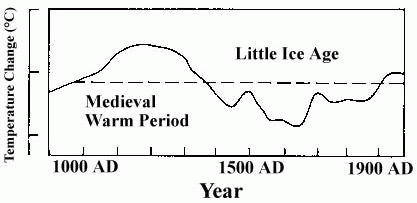
1000 years ago it was warmer than it is now, but with lower CO2. It's also interesting that in the Law Dome graph there was a rise in CO2 in the late 18th century... which is between 50 and 80 years after the temperature rise that started around 1695 in the Central England record. We know that there has been a temperature rise since the end of the Little Ice Age, and that this would be perfectly normal after a period of cold (just like you'd expect ice cream to melt if you leave it out of the freezer). This seems to support the recent papers claiming that CO2 rises after temperature, and that therefore it can't be the cause of warming and may actually be an effect.

_________________
Make everything as simple as possible, but not simpler - Einstein


Top
 Profile Send private message  
 
 Post subject:
PostPosted: Sat Feb 19, 2005 01:36 
Offline
Life Member
Life Member

Joined: Sat Mar 27, 2004 13:50
Posts: 2643
Gatsobait wrote:
This seems to support the recent papers claiming that CO2 rises after temperature, and that therefore it can't be the cause of warming and may actually be an effect.


Probably. There's about 50 times as much CO2 dissolved in the oceans as in the atmosphere and, as anyone who drinks beer knows, cold water holds it's bubbles much better than warm water. So if the oceans warm slightly they give off CO2 - there's your effect.

Regards
Peter


Top
 Profile Send private message  
 
 Post subject:
PostPosted: Sat Feb 19, 2005 03:14 
Offline
Gold Member
Gold Member

Joined: Mon Mar 15, 2004 15:43
Posts: 2416
Gatsobait wrote:
Einion Yrth wrote:
Gatsobait wrote:
basingwerk wrote:
Don't know much about that one. As far as I know, the orbit is subject to Kepler's laws, although there will be perturbations and perhaps the eccentricity vector would evolve as you say. Please give me a source of information on that.
Sorry, I'll have to get back to you on that as well because I keep getting the name wrong. "Malkovich cycle" is in my head, but I know I'm getting it mixed up with John Malkovich.

Milankovitch. HTH
That's the kiddie. Ta. Image

Thanks to Einion Yrth for letting me know it's not Malkovich cycles but Moscovitch cycles, damn I mean Milankovitch cycles :lol: . I found this page, whch says about the 100,000 year eccentricity cycle and climate:
Quote:
Today a difference of only about 3 percent occurs between aphelion (farthest point) and perihelion (closest point). This 3 percent difference in distance means that Earth experiences a 6 percent increase in received solar energy in January than in July. This 6 percent range of variability is not always the case, however. When the Earth's orbit is most elliptical the amount of solar energy received at the perihelion would be in the range of 20 to 30 percent more than at aphelion. Most certainly these continually altering amounts of received solar energy around the globe result in prominent changes in the Earth's climate and glacial regimes. At present the orbital eccentricity is nearly at the minimum of its cycle.


About the 41,000 year axial tilt cycle and climate it says
Quote:
One hypothesis for Earth's reaction to a smaller degree of axial tilt is that it would promote the growth of ice sheets. This response would be due to a warmer winter, in which warmer air would be able to hold more moisture, and subsequently produce a greater amount of snowfall. In addition, summer temperatures would be cooler, resulting in less melting of the winter's accumulation. At present, axial tilt is in the middle of its range.


And about the 23,000 year precession cycle and climate it says
Quote:
Due to this wobble a climatically significant alteration must take place. When the axis is tilted towards Vega the positions of the Northern Hemisphere winter and summer solstices will coincide with the aphelion and perihelion, respectively. This means that the Northern Hemisphere will experience winter when the Earth is furthest from the Sun and summer when the Earth is closest to the Sun. This coincidence will result in greater seasonal contrasts. At present, the Earth is at perihelion very close to the winter solstice.


However, they do say that orbital conditions just initiate changes rather than create them all by themselves, and that subsequent changes depend on some form of feedback.

_________________
Make everything as simple as possible, but not simpler - Einstein


Last edited by Gatsobait on Tue Jun 28, 2005 14:28, edited 1 time in total.

Top
 Profile Send private message  
 
 Post subject:
PostPosted: Mon Feb 21, 2005 18:06 
Offline
Member
Member

Joined: Mon Mar 15, 2004 16:02
Posts: 372
Woosh!

This is a good thread, which I've not had time to read thoroughly 'cos I'm supposed to be working. Just a few small points to make.

1) The original poster mentioned a CO level of 380ppm without reference to a source of info, or where this concentration was supposed to be. If it's at ground level, i suspect a typo from 380 ppb as most car engines and industrial processes in the UK don't put out anywhere near 380ppm. (My source for this is personal experience. it was my job for 11 years). Some processes do, but not THAT many. 380ppm of CO is dangerous! The Occupational exposure limit is 50.

2) Part of the reason why Kyoto will not be effective is that a particular nation with 6% of the world's population has not signed up to it. this nation also puts out 25% of the world's man made pollution. it's called the USA.

3) While i fully support people's right to live how they choose, there is nothing wrong with taking individual resonsibility for the pollution we create and trying to curb it in at least some respects. This doesn';t mean that we have to be overly 'green' and politically correct.

This can mean buying energy saver bulbs when normal ones blow, rather than throw away good bulbs, insulating your home well and cutting heating costs and CO2 etc, keeping boiler and car serviced and tuned properly, recycling when and where facilities and time allow (take empty bottles to the supermarket bank on the same trip as your weekly shop).

4) Many of the developed world's governments have vested interests in developing countries' economies. Otherwise more radical policies for solving hunger, poverty and conflict would be much easier to implement and would work. I suspect we have a long wait for these.


Top
 Profile  
 
 Post subject:
PostPosted: Mon Feb 21, 2005 18:58 
Offline
Gold Member
Gold Member

Joined: Mon Mar 15, 2004 15:43
Posts: 2416
stackmonkey wrote:
1) The original poster mentioned a CO level of 380ppm without reference to a source of info, or where this concentration was supposed to be. If it's at ground level, i suspect a typo from 380 ppb as most car engines and industrial processes in the UK don't put out anywhere near 380ppm. (My source for this is personal experience. it was my job for 11 years). Some processes do, but not THAT many. 380ppm of CO is dangerous! The Occupational exposure limit is 50.
I suspect it's a typo and should have been CO2. At least, that's how I've been treating it since 380ppmv CO2 ain't far out.

_________________
Make everything as simple as possible, but not simpler - Einstein


Top
 Profile Send private message  
 
 Post subject:
PostPosted: Thu Feb 24, 2005 07:24 
Offline
User

Joined: Tue Aug 31, 2004 19:54
Posts: 55
Location: Shropshire
stackmonkey wrote:
Woosh!

This is a good thread, which I've not had time to read thoroughly 'cos I'm supposed to be working. Just a few small points to make.

1) The original poster mentioned a CO level of 380ppm without reference to a source of info, or where this concentration was supposed to be. If it's at ground level, i suspect a typo from 380 ppb as most car engines and industrial processes in the UK don't put out anywhere near 380ppm. (My source for this is personal experience. it was my job for 11 years). Some processes do, but not THAT many. 380ppm of CO is dangerous! The Occupational exposure limit is 50.

.


As the original poster I referred to CO2 at 380ppm, I have looked back for the ref. to Co but haven't found it? Maybe I am missing seeing it, rather like the counting F's exercise in quality control experiments.

Like so many threads on here the development of a subject takes interesting turns, postees bring a depth of debate that promps ever greater detail and I suspect ever more searching for that killer fact that will settle the argument.

Who would have thought a post regarding the excessive use of traffic lights would promp a statement from BMW that we have dead suns in our solar system? and the fascinating debate above between Gatso and Basinwerk, all of which would have been somewhat different if dead suns were lurking in our solar system by the way!

The debate between those who want to change the way we use energy because damage to the atmosphere caused by man, needs to be reversed and those like Pete who think it is all hype, claiming such views fail to recognise the enormity of nature, will go on; long may it all continue though hopefully not so long that we miss the chance to correct our folly.
RJ

_________________
Too much of our money is being wasted on supposed road safety improvements that are actually making driving more dangerous.


Top
 Profile Send private message  
 
 Post subject:
PostPosted: Thu Feb 24, 2005 10:22 
Offline
Banned
Banned

Joined: Thu Apr 15, 2004 12:47
Posts: 2291
stackmonkey wrote:
Woosh!This can mean buying energy saver bulbs when normal ones blow, rather than throw away good bulbs, insulating your home well and cutting heating costs and CO2 etc, keeping boiler and car serviced and tuned properly, recycling when and where facilities and time allow (take empty bottles to the supermarket bank on the same trip as your weekly shop).


Can't do any harm, can it? There was an interview on Radio 4 with Michael Mann, author of the Hockey Stick paper, strongly supporting the notion that global warming is mostly due to modern industry. In the interview, he accused his detractors, Stephen MacIntyre and Ross McKitrick, of ad hominem, vitriolic attacks, and of falsifing and misrepresenting the data. He asserted that the mini-ice age was not as significant a departure from the norm as some think, and that global temperatures in the latter half of the 20th century were higher than at any time in the last 2,000 years.

It seems that this one wil run and run, until it is too late to save the world!

_________________
I stole this .sig


Top
 Profile  
 
Display posts from previous:  Sort by  
Post new topic Reply to topic  [ 125 posts ]  Go to page Previous  1, 2, 3, 4, 5, 6, 7  Next

All times are UTC [ DST ]


Who is online

Users browsing this forum: No registered users and 0 guests


You cannot post new topics in this forum
You cannot reply to topics in this forum
You cannot edit your posts in this forum
You cannot delete your posts in this forum
You can post attachments in this forum

Search for:
Jump to:  
cron
Powered by phpBB® Forum Software © phpBB Group
[ Time : 0.027s | 11 Queries | GZIP : Off ]